

If you are wondering whether gray or grey is correct, the answer is that both spellings are standard English. The main difference is regional. Gray is the usual spelling in American English, while grey is especially associated with British English. Cambridge and Oxford both identify this U.S./British distinction.
The two forms normally have the same meaning and pronunciation. They can function as adjectives, nouns, and verbs. For example, an American writer might write gray hair, while a British writer would normally write grey hair. The important point is not to treat one form as a universal spelling error. Instead, choose the spelling that matches your variety of English, audience, or required style guide.
Quick Answer
Both gray and grey are correct spellings of the same word. Use gray in standard American English and grey in British English. The words normally have the same meaning and pronunciation. The same regional distinction appears in forms such as grayed/greyed and graying/greying.
TL;DR
- Gray is the standard American English spelling.
- Grey is the standard British English spelling.
- Both forms normally have the same meaning.
- Both are pronounced /ɡreɪ/.
- Related forms follow the same regional pattern.
- Fixed names such as Greyhound keep their established spelling.
Gray vs. Grey at a Glance
| Feature | Gray | Grey |
|---|---|---|
| Main variety | American English | British English |
| Basic meaning | Color between black and white | Same |
| Pronunciation | /ɡreɪ/ | /ɡreɪ/ |
| Adjective | gray hair | grey hair |
| Noun | a shade of gray | a shade of grey |
| Verb | hair grayed | hair greyed |
| -ing form | graying | greying |
| Common expression | gray area | grey area |
Cambridge identifies gray as the U.S. spelling and grey as mainly the U.K. spelling. Oxford likewise lists gray as the U.S. form and grey as especially British.
Is Gray or Grey the Correct Spelling?
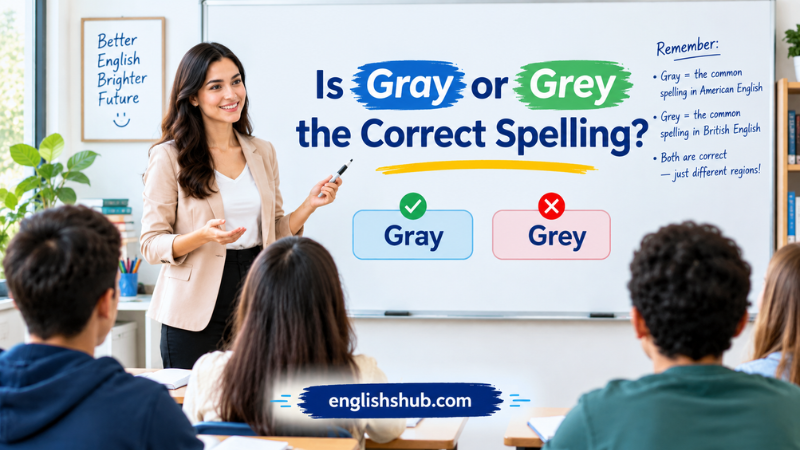
Both are correct. The choice depends mainly on the variety of English you are using.
For American English:
The sky turned gray before the storm.
For British English:
The sky turned grey before the storm.
Neither sentence is wrong. The spelling simply reflects a different regional convention.
If you are writing for an American audience, gray is normally the appropriate choice. If you are following British English, grey is normally preferred.
This distinction is similar to other regional pairs such as color/colour and favorite/favourite. It is a spelling difference rather than a difference in the underlying word.
Gray in American English
In American English, gray is the usual spelling.
You will commonly see it in phrases such as:
- gray hair
- gray eyes
- gray sky
- gray jacket
- gray clouds
- gray area
- gray matter
- gray whale
For example:
- My grandfather’s hair is turning gray.
- The gray sky made the afternoon look darker.
- The contract contains a legal gray area.
- She chose a gray suit for the interview.
Cambridge’s American entry gives gray as the U.S. form and includes uses for color, hair, weather, and gray area.
Grey in British English
In British English, grey is the usual spelling.
Examples include:
- grey hair
- grey eyes
- grey sky
- grey jacket
- grey clouds
- grey area
- grey matter
For example:
- His hair has started to turn grey.
- The grey clouds covered the sky.
- The issue remains a legal grey area.
- She wore a dark grey coat.
Cambridge labels grey as mainly British and gives the same basic color meaning as gray.
Do Gray and Grey Mean the Same Thing?
In ordinary usage, yes. Gray and grey are spelling variants of the same word.
Both can describe:
- The color between black and white.
- Hair that has become gray or white.
- Cloudy or dull weather.
- Certain figurative ideas, such as an unclear situation.
For example:
- American: The instructions leave a gray area.
- British: The instructions leave a grey area.
The expression gray area/grey area refers to something that is unclear or does not have a simple rule. Cambridge specifically records this meaning.
Gray and Grey as Different Parts of Speech
The word can perform several grammatical jobs.
As an adjective
It describes something that has the color or quality associated with gray or grey.
- She bought a gray sweater.
- He wore a grey suit.
As a noun
It can name the color itself.
- Gray is a neutral color.
- She painted the room in several shades of grey.
Oxford lists gray/grey as nouns referring to the color and also records a noun use for a gray or white horse.
As a verb
It can describe hair becoming gray or grey.
- His hair is graying.
- Her hair is greying.
Oxford lists gray as an intransitive verb meaning for hair to become gray, with grayed and graying as its forms.
Grayed or Greyed? Graying or Greying?
The same regional pattern normally continues in related forms.
| American English | British English |
|---|---|
| gray | grey |
| grayed | greyed |
| graying | greying |
| grayish | greyish |
For example:
American English
- His hair is graying.
- The old photograph has grayed with age.
British English
- His hair is greying.
- The old photograph has greyed with age.
Cambridge specifically identifies graying as the U.S. spelling of greying.
The practical rule is simple: once you choose a regional spelling, apply it to related forms when that regional variation exists.
Gray Area or Grey Area?
Both gray area and grey area are correct.
The choice follows the same regional pattern:
- U.S. English: gray area
- British English: grey area
The phrase describes a situation that is unclear, uncertain, or not governed by an obvious rule.
Examples:
- The contract leaves a gray area concerning overtime.
- The contract leaves a grey area concerning overtime.
Do not assume that gray area refers to a physical color. It often has a figurative meaning involving uncertainty.
How to Choose Gray or Grey in American Writing
If you are writing for a U.S. audience, use this simple rule:
American English → gray
For example:
- gray hair
- gray clouds
- gray walls
- gray matter
- gray area
This is especially useful for school assignments, business writing, websites, reports, and other standard American English contexts.
If your employer, publisher, teacher, or organization follows another style, follow that requirement instead.
The important principle is consistency. A document that uses American English normally looks cleaner when it consistently uses gray and related American forms.
Avoid Mixing Regional Spellings Without a Reason
Mixing gray and grey in the same document is not automatically a grammar error. However, unexplained switching can make the spelling system look inconsistent.
For example:
The gray walls matched the grey furniture.
There is no grammatical problem with the sentence. But if the entire document is supposed to follow American English, a consistent version would be:
The gray walls matched the gray furniture.
A British-English version would be:
The grey walls matched the grey furniture.
There are legitimate reasons for keeping both spellings, such as discussing regional English or preserving an original proper name or quotation.
When Should You Keep the Spelling “Grey” in American English?
American English does not require you to change every occurrence of grey.
Keep the established spelling when it is part of a proper name, title, brand, or fixed term.
For example:
- Greyhound
- Earl Grey
- Grey’s Anatomy
The spelling of a proper name belongs to the name itself. You should not automatically change it simply because your surrounding prose uses American English.
Similarly, if you quote a British source, preserve the source’s original spelling when accuracy requires it.
This is an important exception to the simple “U.S. = gray” rule.
Are Gray and Grey Pronounced Differently?
No. In ordinary English, gray and grey have the same pronunciation: /ɡreɪ/.
The sound is the same even though the written forms differ. Cambridge gives /ɡreɪ/ for both forms.
That explains why spelling can be confusing. Someone may hear the word without knowing whether the writer would use gray or grey.
Compare:
- gray → /ɡreɪ/
- grey → /ɡreɪ/
The difference is visual, not normally phonetic.
Gray or Grey: Common Examples
Here are paired examples showing how the same sentence changes between U.S. and British English.
| American English | British English |
|---|---|
| The sky is gray. | The sky is grey. |
| She has gray hair. | She has grey hair. |
| He bought a gray coat. | He bought a grey coat. |
| The building has gray walls. | The building has grey walls. |
| The issue is a gray area. | The issue is a grey area. |
| His beard is graying. | His beard is greying. |
Notice that the grammar and meaning remain the same. The main difference is the regional spelling.
Gray vs. Related Color Words
Words such as silver, charcoal, and slate can describe colors related to gray, but they are not perfect synonyms.
| Word | General meaning | Why it is not always interchangeable |
|---|---|---|
| gray/grey | Neutral color between black and white | Broad category |
| silver | Gray with a metallic or reflective quality | Often suggests shine |
| charcoal | Very dark gray | More specific and darker |
| slate | Usually a cool gray associated with slate | Can suggest a blue or cool undertone |
| ash | A pale gray tone | Usually suggests a lighter shade |
For example, you could say:
She painted the wall gray.
But replacing gray with silver may suggest a metallic finish:
She painted the wall silver.
Likewise, charcoal is more specific than ordinary gray. These words are related color terms, but they are not interchangeable in every context.
Why Are There Two Spellings?
The two forms have a long history in English. Oxford traces grey to Old English grǣg, with Germanic relationships including Dutch grauw and German grau.
Over time, different spelling traditions became established in different varieties of English. American English settled on gray as its usual form, while grey remained especially common in British English.
The useful modern rule does not require memorizing the entire history:
U.S. English → gray
British English → grey
The two forms are not the result of one spelling being “wrong.” They are established regional variants.
A Simple Memory Trick for Gray vs. Grey
Use the first vowel of the regional name:
A → America → gray
E → England → grey
This is only a memory aid, not the historical explanation for the spellings. However, it is useful when you need to make a quick choice.
For American writing:
gray
For British writing:
grey
If your publication follows a specific house style, use its preferred form instead.
Common Mistakes With Gray and Grey
Mistake 1: Calling grey universally incorrect
Incorrect assumption: “Grey is always misspelled.”
That is not true. Grey is a standard British spelling.
Mistake 2: Calling gray universally incorrect
Incorrect assumption: “Gray is an American mistake.”
That is also false. Gray is the standard U.S. spelling.
Mistake 3: Mixing related forms
For example:
My favorite color is grey.
This may be appropriate in a discussion comparing varieties, but an American-English document would normally use:
My favorite color is gray.
A British-English document would normally use:
My favourite colour is grey.
Mistake 4: Changing a proper name
Do not change an established name simply to match your regional spelling.
For example, Greyhound should retain its established spelling.
Mistake 5: Assuming pronunciation tells you the spelling
Because gray and grey sound the same, pronunciation alone cannot tell you which spelling to choose.
How to Choose the Right Form: A Three-Step Test
When you are unsure, use this process.
Step 1: Identify your English variety
Are you writing standard American English?
If yes, choose gray.
Are you following British English?
If yes, choose grey.
Step 2: Check the required style
A school, employer, publisher, or organization may have a house style.
Follow that style even when another spelling is also standard.
Step 3: Stay consistent
Once you choose your regional system, use the corresponding forms throughout the document.
American system:
- gray
- grayed
- graying
British system:
- grey
- greyed
- greying
This consistency is more useful than trying to decide which spelling is “better.”
FAQs
Is gray or grey correct?
Both are correct. Gray is the standard spelling in American English, while grey is the usual British spelling. The two forms normally have the same meaning and pronunciation.
Is grey wrong in American English?
No. Grey is a recognized English spelling, but gray is the normal choice for standard American English. Use grey when it is part of a proper name, quotation, or a context that intentionally follows British usage.
Is gray wrong in British English?
No. Gray is recognizable in British English, but grey is the usual British form. Writers following British spelling conventions normally choose grey.
Do gray and grey have the same pronunciation?
Yes. Both are normally pronounced /ɡreɪ/. The spelling changes, but the pronunciation does not normally change.
Is it gray hair or grey hair?
Both are correct. American English normally uses gray hair, while British English normally uses grey hair.
Is it gray area or grey area?
Both forms are correct. Use gray area in American English and grey area in British English. The expression usually describes an unclear or uncertain situation.
Is “graying” or “greying” correct?
Both are correct regional forms. Graying is the U.S. spelling, while greying is the British spelling. Cambridge explicitly identifies graying as the U.S. form of greying.
Test Your Understanding
1. Which spelling is standard in American English?
A. Grey
B. Gray
C. Grae
D. Grei
2. Which sentence follows standard American English spelling?
A. The sky turned grey.
B. Her hair is greying.
C. He bought a gray jacket.
D. The issue is a grey area.
3. What is the main difference between gray and grey?
A. They have different meanings.
B. They have different pronunciations.
C. They are different regional spellings.
D. One is an adjective and the other is a noun.
4. Which form normally fits British English?
A. graying
B. grayed
C. gray hair
D. greying
5. Why might an American writer keep the spelling “Grey”?
A. Because grey is always more formal
B. Because American English requires grey in legal writing
C. Because it may belong to a proper name or quotation
D. Because gray and grey have different pronunciations
Answer Key
- B. Gray is the standard American English spelling.
- C. American English normally uses gray jacket.
- C. The main difference is regional spelling, not ordinary meaning or pronunciation.
- D. Greying is the British form corresponding to U.S. graying.
- C. Proper names and quotations may preserve their established original spelling.
Conclusion
When choosing gray or grey, use the variety of English you are following as your guide. Gray is standard in American English, while grey is standard in British English. Both normally have the same meaning and pronunciation, and the regional pattern extends to forms such as grayed/greyed and graying/greying. For U.S. writing, the simplest rule is to choose gray and use the corresponding American forms consistently.
Related Grammar and Language Guides
Favor or Favour? Correct Spelling and Usage
Color or Colour: Correct Spelling, Difference & Examples
Enquiry or Inquiry: Which Spelling Should You Use?