
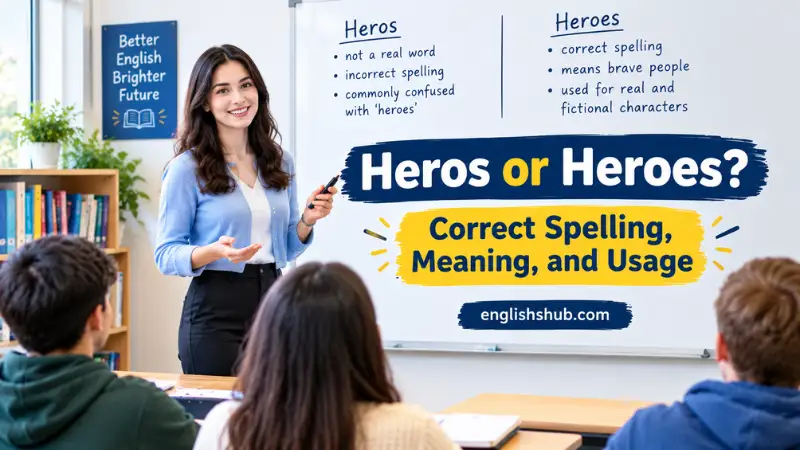
If you are choosing between heros or heroes, use heroes when you mean more than one hero. A hero can be a brave or admired person, an important character in a story, or someone regarded as a role model. The standard plural for these meanings is heroes, with -es at the end. Oxford lists heroes as the plural of hero, and Cambridge gives the same plural form.
The form heros is not the standard plural for heroic people or fictional characters. However, there is a narrow U.S. usage worth knowing: some dictionaries record heros as a rare plural when hero means a type of sandwich.
So, for ordinary English writing, remember this simple pair:
one hero → two heroes
Quick Answer
Heroes is the correct standard plural of hero when you mean two or more admired people, brave individuals, or fictional characters. Write hero for one and heroes for more than one. Heros is not the normal plural in this meaning. Some dictionaries record heros as a rare U.S. plural for the sandwich sense of hero.
TL;DR
- Use hero for one person or character.
- Use heroes for two or more.
- Heros is not the standard plural for heroic people.
- Hero can also mean a type of U.S. sandwich.
- Some dictionaries record heros as a rare sandwich plural.
- Hero’s and heroes’ are possessive forms, not ordinary plurals.
Heros or Heroes at a Glance
| Form | Standard use | Example |
|---|---|---|
| hero | One person or character | She is a hero. |
| heroes | More than one hero | They are heroes. |
| heros | Rare specialized sandwich plural | The deli serves several heros. |
| hero’s | Possession by one hero | The hero’s shield broke. |
| heroes’ | Possession by multiple heroes | The heroes’ shields broke. |
For ordinary references to people or characters, heroes is the form to choose. Oxford directly lists heroes as the plural, while Cambridge does the same.
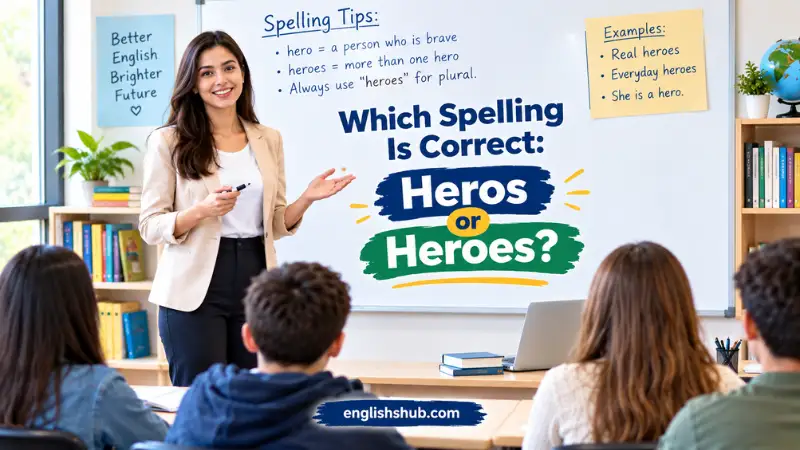
Which Spelling Is Correct: Heros or Heroes?
The standard spelling is heroes.
The basic form is:
hero → heroes
Examples:
- The firefighter became a hero.
- The firefighters became heroes.
- The novel has one main hero.
- The novel has several heroes.
- The volunteers were celebrated as heroes.
The extra e matters. Do not write heros when you mean multiple heroic people or characters.
Oxford’s entry also shows that hero can describe someone admired for doing something brave or good and can refer to a main character in a story, novel, or film.
Correct
The rescue workers were praised as heroes.
Incorrect
The rescue workers were praised as heros.
The second spelling may look logical because many English plurals simply add -s. However, English has several established plural patterns, so the spelling of each common word matters.
Why Is the Plural Heroes, Not Heros?
The spelling heroes is an established plural form. A useful way to remember it is:
hero + es = heroes
Several familiar nouns ending in -o also take -es:
| Singular | Plural |
|---|---|
| hero | heroes |
| potato | potatoes |
| tomato | tomatoes |
| echo | echoes |
English does not, however, have one universal rule saying every noun ending in -o must take -es. Compare:
| Singular | Plural |
|---|---|
| photo | photos |
| piano | pianos |
| radio | radios |
| studio | studios |
That difference explains why heros can look reasonable. A writer may remember words such as photos and radios and assume hero works the same way.
It does not.
For hero, learn the established pair:
hero → heroes
EnglishShub’s related guide on tomatoes also demonstrates this contrast between tomato → tomatoes and nouns such as photo → photos.
Is Heros Ever Correct?
There is an important qualification: heros can occur in a specialized context.
In American English, hero can refer to a type of long sandwich. Dictionary.com records heros as a rare plural for that food meaning and specifically describes the ordinary plural of hero as heroes.
For example, you might encounter:
The deli prepared several Italian heros.
This is a specialized food usage. It does not mean that heros is an alternative spelling you can freely use for brave people.
For ordinary writing:
The firefighters were heroes.
Not:
The firefighters were heros.
Dictionary sources differ somewhat in how they handle the sandwich plural. Dictionary.com records heros, while Oxford lists hero as a North American sandwich term but gives the ordinary lexical entry as plural heroes.
Therefore, the safest general rule for learners is:
Use heroes when you mean multiple people or characters. Recognize heros only as a specialized form you may encounter in U.S. food-related usage.
Hero, Heroes, Hero’s, and Heroes’: What Is the Difference?
These four forms are easy to confuse:
- hero = one hero
- heroes = more than one hero
- hero’s = belonging to one hero
- heroes’ = belonging to multiple heroes
Compare these sentences:
The hero arrived.
One person arrived.
The heroes arrived.
More than one person arrived.
The hero’s costume was damaged.
The costume belongs to one hero.
The heroes’ costumes were damaged.
The costumes belong to multiple heroes.
Do Not Use an Apostrophe to Make a Plural
Apostrophes do not normally make ordinary nouns plural.
Incorrect:
The hero’s saved the town.
Correct:
The heroes saved the town.
The apostrophe changes the grammatical function. It does not simply add the meaning “more than one.”
Hero vs. Heroes in Sentences
The easiest way to choose between the two is to check the number.
One Person: Hero
Use hero for one person:
- My father is my hero.
- The firefighter became a hero.
- She was called a national hero.
- The athlete became a hero to young fans.
- The novel’s hero faces a difficult decision.
More Than One: Heroes
Use heroes for two or more:
- The firefighters became heroes.
- The athletes were celebrated as heroes.
- Many volunteers became community heroes.
- The novel follows three heroes.
- The children admired their favorite comic-book heroes.
Oxford also provides examples involving “national heroes,” “unsung heroes,” and “football heroes,” showing the normal plural in natural usage.
Check the Verb Too
Because heroes is plural, it normally takes plural verb forms.
Incorrect:
The heroes is ready.
Correct:
The heroes are ready.
Compare:
The hero is ready.
The heroes are ready.
This is ordinary subject-verb agreement.
What About Superheroes?
The same spelling principle applies to compound words containing hero.
The standard forms are:
superhero → superheroes
Not:
superhero → superheros
Dictionary.com lists superheroes as the plural of superhero.
Examples:
- The movie features several superheroes.
- Children often recognize famous superheroes.
- The comic introduces two new superheroes.
- The superheroes work together to save the city.
The extra e remains part of the established spelling.
Other compounds can follow the same pattern:
- superhero → superheroes
- subhero → subheroes
The important point is not to treat heros as the ordinary plural ending for words containing hero.
American and British English: Is There a Difference?
For the ordinary plural, there is no standard American-versus-British spelling difference.
Use:
- American English: heroes
- British English: heroes
Cambridge lists heroes as the plural of hero, and Oxford likewise gives heroes.
This is different from genuine regional spelling pairs such as:
- American color / British colour
- American favor / British favour
Do not change heroes to heros simply because you are writing for a different English-speaking country.
The specialized sandwich sense is more closely associated with North American English. Oxford identifies hero as a North American term for a long sandwich, while Dictionary.com records the rare heros plural in that sense.
Hero, Heroine, and Protagonist
Some related words can create another kind of confusion.
Hero and Heroine
Hero can refer to an admired person or a principal character. Heroine traditionally refers to a female hero or principal female character.
Their plurals are:
- hero → heroes
- heroine → heroines
Dictionary.com lists heroine and heroines as the corresponding forms.
Modern English also uses hero more broadly as a gender-neutral term in many contexts. Therefore, do not assume that heroes must refer only to men. Context determines the intended meaning.
Hero and Protagonist
Protagonist is a useful related word, but it is not a perfect synonym.
A protagonist is the central or leading character in a story. A hero can be the central character, but hero also describes a person admired for courage or achievement.
For example:
The novel’s protagonist makes several difficult choices.
This identifies the central character.
The firefighter is a hero.
This emphasizes admiration or bravery.
Dictionary.com discusses the overlap and limits between hero and protagonist.
So use the word that matches your intended meaning rather than treating the terms as interchangeable in every sentence.
Common Mistakes With Heros and Heroes
1. Writing Heros for the Ordinary Plural
Incorrect:
The rescue workers were heros.
Correct:
The rescue workers were heroes.
The people are being described as brave or admirable, so heroes is the standard plural.
2. Writing Superheros
Incorrect:
The movie has several superheros.
Correct:
The movie has several superheroes.
The standard plural of superhero is superheroes.
3. Using Hero’s as a Plural
Incorrect:
The hero’s arrived early.
Correct:
The heroes arrived early.
Use hero’s when the form shows possession by one hero or represents a contraction in a suitable context.
4. Using a Singular Verb With Heroes
Incorrect:
The heroes is ready.
Correct:
The heroes are ready.
The plural noun heroes normally takes a plural verb.
5. Writing Heroes’ When You Mean a Simple Plural
Incorrect:
The heroes’ entered the building.
Correct:
The heroes entered the building.
The apostrophe in heroes’ indicates possession. It is not needed for an ordinary plural.
A Simple Decision Rule
When you see heros or heroes, ask one question:
Am I talking about more than one heroic person or character?
If the answer is yes, write:
heroes
If you are talking about one, write:
hero
If you encounter heros, check whether the context is the specialized U.S. sandwich sense or a proper name. Otherwise, it is probably a spelling mistake.
The Fastest Memory Aid
Remember:
One hero, two heroes.
Or break the plural apart:
hero + es = heroes
This is safer than trying to memorize a universal rule for every noun ending in -o.
Correct and Incorrect Examples
| Incorrect or specialized form | Standard form | Why |
|---|---|---|
| The firefighters were heros. | The firefighters were heroes. | Ordinary plural |
| The story has three heros. | The story has three heroes. | Multiple characters |
| The movie features several superheros. | The movie features several superheroes. | Standard compound plural |
| The hero’s arrived. | The heroes arrived. | No apostrophe for a regular plural |
| The heroes is ready. | The heroes are ready. | Plural subject |
| The heroes’ arrived. | The heroes arrived. | Apostrophe incorrectly added |
| The hero’s shield broke. | The hero’s shield broke. | Singular possession |
| The heroes’ shields broke. | The heroes’ shields broke. | Plural possession |
The distinction becomes much easier when you separate number from possession.
FAQs
Heroes is correct when you mean more than one heroic person, admired individual, or fictional character. Heros is not the standard plural for these meanings. Some dictionaries record heros as a rare plural for the U.S. sandwich sense of hero.
The standard plural is heroes. Oxford lists heroes directly as the plural form of hero, and Cambridge does the same.
Hero has an established plural ending in -es, producing heroes. However, nouns ending in -o do not all follow the same pattern. For example, photo becomes photos, while hero becomes heroes.
Yes, but its ordinary use is limited. Dictionary.com records heros as a rare plural when hero means a type of sandwich. It should not be used as the normal plural for heroic people or fictional characters.
Yes. Heroes is the standard American English plural of hero. The ordinary plural does not change to heros in American English. Cambridge’s American English entry gives heroes as the plural.
Yes. British English also uses heroes as the ordinary plural. There is no standard British spelling change from heroes to heros. Oxford lists heroes as the plural.
multiple heroes.
The hero’s cape was red.
The heroes’ capes were red.
Neither apostrophe form is simply another spelling of the ordinary plural.
Hero’s normally means something belonging to one hero. Heroes’ means something belonging to
Test Your Understanding
1. Which sentence uses the standard plural of hero?
A. The firefighters became heros.
B. The firefighters became heroes.
C. The firefighters became hero’s.
D. The firefighters became hero.
2. Which form means more than one hero?
A. hero’s
B. heros
C. heroes
D. hero
3. Which sentence is correct?
A. The heroes is here.
B. The hero’s are here.
C. The heroes are here.
D. The heros are here.
4. Which sentence correctly shows possession by multiple heroes?
A. The heroes shield was damaged.
B. The hero’s shields were damaged.
C. The heroes’ shields were damaged.
D. The heros’ shields were damaged.
5. Which spelling is standard for more than one superhero?
A. superheros
B. superheroes
C. superhero’s
D. superheroe
Answer Key
- B — Heroes is the standard plural of hero for people or characters.
- C — Heroes means more than one hero.
- C — The plural subject heroes takes the plural verb are.
- C — Heroes’ shows possession by multiple heroes.
- B — The standard plural of superhero is superheroes.
Conclusion
For the ordinary spelling question heros or heroes, choose heroes when you mean more than one heroic person, admired figure, or fictional character. The standard pair is hero → heroes. The form heros has a narrow documented use as a rare plural for the U.S. sandwich sense of hero, but it is not the normal plural for people or characters. When in doubt, remember: one hero, two heroes.
Related Grammar and Language Guides
Babys or Babies: Correct Spelling, Rules, and Examples
Flys or Flies: Correct Spelling, Rules, and Examples
Gasses or Gases: Correct Spelling, Meaning, and Examples