
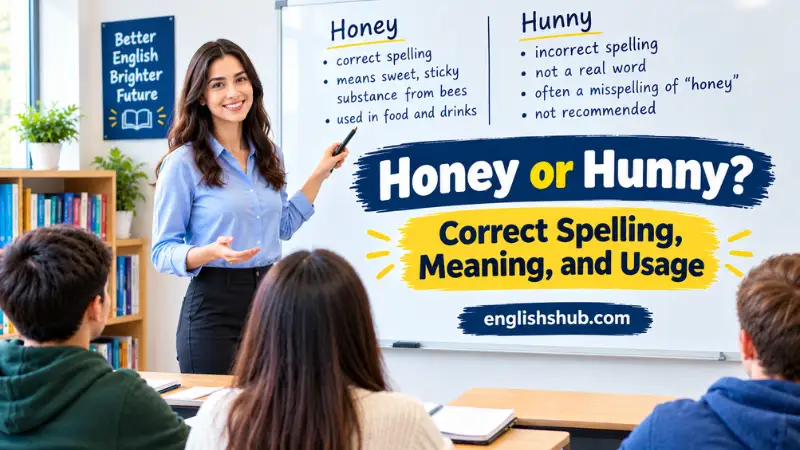
The choice between honey or hunny depends on what you mean and how you want the writing to sound. Honey is the standard English spelling. It refers to the sweet substance made by bees, and it can also be used as an affectionate form of address. Cambridge Dictionary also recognizes hunny as an informal alternative spelling of honey when speaking to someone you like, love, or want to address warmly.
That means hunny is not simply a random spelling mistake in every context. However, it has a much narrower use. If you are writing about food, preparing a recipe, doing schoolwork, or writing standard professional English, honey is the form to use.
Quick Answer
Honey is the standard spelling in American English. Use it for the food made by bees and for the conventional spelling of the affectionate term of address. Hunny is an informal alternative spelling mainly used when addressing someone affectionately or creating a playful tone. Cambridge Dictionary specifically labels hunny informal.
TL;DR
- Honey is the standard spelling.
- Hunny is an informal alternative spelling.
- Use honey when referring to the food made by bees.
- Use honey for a conventional term of affection.
- Hunny can create a cute or playful tone in personal messages.
- Both forms are pronounced /ˈhʌn.i/ in the cited Cambridge entries.
Honey or Hunny at a Glance
| Form or context | Standard? | Main use | Example |
|---|---|---|---|
| honey | Yes | Food made by bees | Add honey to the tea. |
| honey | Yes | Term of affection | Thanks, honey. |
| hunny | Informal | Affectionate address | Good night, hunny. |
| hunny | Informal | Playful written style | Miss you, hunny! |
| hunny for the food | No | Not the standard food spelling | Use honey instead. |
Is “Honey” the Standard Spelling?
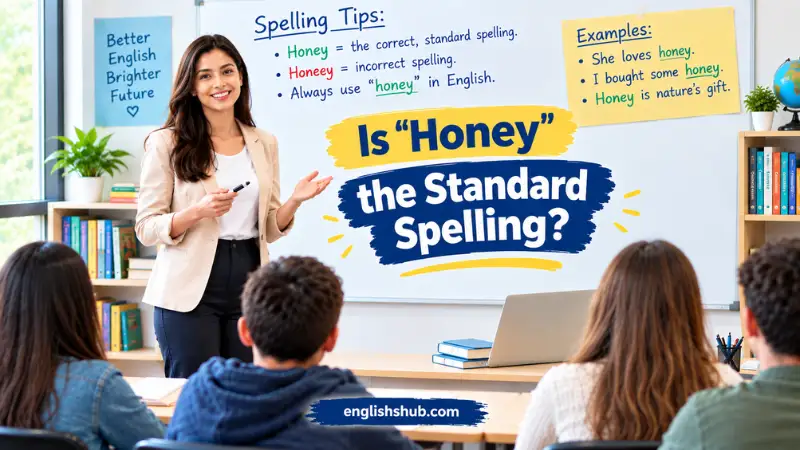
Yes. Honey is the established standard spelling.
As a noun, it commonly refers to the sweet, sticky substance made by bees and used as food. Cambridge lists this as a standard noun meaning and classifies it as uncountable in this sense.
For example:
- The recipe calls for two tablespoons of honey.
- She added honey to her tea.
- Bees produce honey from nectar.
- We bought a jar of local honey.
- The bread tastes good with honey.
The same spelling is also standard when honey is used as a form of address:
- Good morning, honey.
- Are you okay, honey?
- Thanks for helping me, honey.
- Come here, honey.
Cambridge describes this use as a name used to address someone you love or like very much and labels it mainly U.S.
Is “Hunny” a Correct Word?
Hunny is a recognized informal spelling, but it is not the standard spelling of the food word.
This distinction matters. It would be too broad to say that hunny can never be correct. Cambridge has a dedicated hunny entry and defines it as an informal alternative spelling of honey used as a form of address.
So these sentences have different statuses:
Standard:
I put honey in my tea.
Standard affectionate use:
Good night, honey.
Informal alternative:
Good night, hunny.
But this is not the normal standard spelling:
I put hunny in my tea.
When hunny appears in a personal message, the writer may be intentionally choosing a playful or stylized spelling. The unusual spelling can communicate tone as well as meaning.
What Does “Honey” Mean?
Honey has two especially common everyday uses.
1. Honey as a food
The literal meaning refers to the sweet substance produced by bees and used as food.
Examples:
- Honey is often used as a sweetener.
- The beekeeper sells raw honey.
- I spread honey on my toast.
- The cake contains honey instead of some of the sugar.
2. Honey as a term of affection
Honey can also be used when addressing someone affectionately.
Examples:
- Honey, could you help me?
- Thanks, honey.
- Are you feeling better, honey?
- Good morning, honey.
This use is not limited to romantic relationships. Context determines whether the word sounds romantic, familial, friendly, warm, or overly familiar.
Cambridge specifically identifies honey as a form of address for someone you love or like very much.
What Does “Hunny” Mean?
Hunny generally carries the same affectionate meaning as honey when it is used as an informal form of address.
Cambridge defines hunny as an informal alternative spelling of honey and gives examples in which it addresses someone affectionately.
For example:
- Good morning, hunny.
- Sleep tight, hunny.
- Call me when you arrive, hunny.
- I miss you, hunny.
The spelling is therefore especially suited to casual personal communication.
Compare:
Good night, honey.
This is the conventional spelling.
Good night, hunny.
This is more deliberately informal or playful.
The basic affectionate meaning can remain the same. The spelling changes the style and tone.
Honey or Hunny: Pronunciation
Both honey and hunny are pronounced /ˈhʌn.i/ in the Cambridge entries.
A simple approximation for American English is HUN-ee.
That pronunciation helps explain the spelling confusion. When people hear the word, the first syllable can sound like hun, which may encourage some writers to spell the word hunny.
However, English spelling does not always reproduce pronunciation letter by letter. The established spelling is honey.
So remember:
Sound: /ˈhʌn.i/
Standard spelling: honey
Informal alternative: hunny
When Should You Use “Honey”?
Use honey whenever you want standard English or when the word refers to the food.
Choose honey in:
- Recipes
- School assignments
- Articles
- Academic writing
- Professional writing
- Menus
- Product descriptions
- General informational writing
- Ordinary affectionate messages
Examples:
Please add one teaspoon of honey.
The farm produces organic honey.
The recipe uses honey instead of syrup.
Thanks, honey.
Good night, honey.
The important point is that you do not need hunny to make an affectionate message warm. Honey is already the standard affectionate form.
When Can You Use “Hunny”?
Use hunny when you deliberately want an informal, playful, or stylized spelling.
It can fit naturally in:
- Personal texts
- Casual captions
- Affectionate messages
- Character dialogue
- Playful usernames or creative names
- Informal online communication
For example:
Good morning, hunny!
Miss you, hunny.
Hey hunny, how was your day?
In each case, the writer is addressing someone affectionately.
However, the choice is about style, not a new standard spelling of the food.
A useful rule is:
If you want conventional English, use honey. If you intentionally want a playful spelling for an affectionate address, hunny can work.
Honey vs. Hunny in Formal and Informal Writing
Register is one of the most useful ways to understand the difference.
| Situation | Preferred form | Example |
|---|---|---|
| Recipe | honey | Add honey to the sauce. |
| School assignment | honey | Bees produce honey. |
| Professional article | honey | The product contains honey. |
| Neutral personal message | honey | Good night, honey. |
| Playful text | hunny can work | Good night, hunny! |
| Fictional character using stylized spelling | hunny can work | “Come here, hunny.” |
A spelling does not become standard merely because many people use it online. At the same time, an informal spelling does not automatically become meaningless.
Cambridge’s separate hunny entry is important here because it confirms that the form has a recognized informal use.
Common Mistakes With Honey and Hunny
Mistake 1: Using “hunny” for the food
Incorrect in standard English:
I added hunny to my tea.
Correct:
I added honey to my tea.
The standard spelling for the bee-produced food is honey.
Mistake 2: Saying “hunny” is always wrong
That is too absolute.
Cambridge recognizes hunny as an informal alternative spelling when used as a form of address.
So this can be intentional:
Good night, hunny.
Mistake 3: Assuming honey and hunny have different pronunciations
They are represented with the same pronunciation /ˈhʌn.i/ in the Cambridge entries.
Mistake 4: Using an affectionate form in a professional relationship
Even honey, the standard spelling, may sound too familiar in some professional situations.
For example, instead of:
Thanks, honey.
a workplace message might simply say:
Thank you for your help.
The issue here is tone and relationship, not spelling.
Mistake 5: Treating every unusual spelling as an error
A writer may intentionally alter a word’s spelling for a nickname, character voice, joke, or playful message.
Context should come before correction.
An Easy Choice Test
When you are unsure between honey or hunny, ask three questions.
1. Am I talking about the food?
Use honey.
The honey tastes delicious.
2. Am I using the word as a normal term of affection?
Use honey.
Are you okay, honey?
3. Am I intentionally creating a cute or playful spelling?
Hunny can work.
Miss you, hunny!
This test handles most everyday situations.
If you are still unsure, choose honey. It is the standard spelling and works for both the food and the conventional affectionate use.
Honey Word Forms and Related Usage
The standard word honey can appear in ordinary grammatical forms.
For example:
- honey — singular or uncountable noun depending on meaning
- honeys — possible when referring to different types or varieties
- honey’s — singular possessive or contraction in an appropriate context
- honeys’ — plural possessive when a plural countable use requires it
For example:
The store sells several local honeys.
The honey’s flavor is unusually mild.
However, do not add an apostrophe simply because you mean more than one affectionate nickname.
An apostrophe is not normally used to make an ordinary plural.
Honey, Hunny, and Other Affectionate Terms
Honey belongs to a larger group of affectionate forms of address. English also uses words such as dear, sweetheart, darling, sweetie, and babe.
These words overlap in function, but they are not exact substitutes in every situation.
For example:
Thanks, honey.
Thanks, sweetheart.
Thanks, dear.
All can express warmth, but they may suggest different relationships, ages, regions, or tones.
Likewise, hunny is not simply a stronger version of honey. Its main difference is the deliberately informal spelling.
The safest approach is to choose the word that matches both the relationship and the level of formality.
FAQs
Honey is the standard spelling. Hunny is an informal alternative spelling recognized for affectionate forms of address. Use honey in standard writing and hunny when a playful or deliberately informal spelling fits the context.
Yes, hunny has a dictionary-recognized informal use. Cambridge lists it as an alternative spelling of honey used as a form of address. That does not make it the standard spelling for the food produced by bees.
Yes. In a personal message, hunny can intentionally create a cute, affectionate, or playful tone. For example, “Good night, hunny” is understandable as an informal spelling of the affectionate honey.
Use honey. The standard noun for the sweet substance made by bees is honey. Hunny is not the standard spelling for this meaning.
The Cambridge entries give both forms the pronunciation /ˈhʌn.i/. In ordinary American English, they are therefore pronounced alike in the cited dictionary entries.
Yes. Honey is commonly used as an affectionate form of address. Cambridge specifically identifies this use as a name used to address someone you love or like very much.
No. Cambridge labels hunny informal. It is better suited to affectionate, playful, or casual communication than to formal or academic writing.
Test Your Understanding
1. Which spelling should you use when referring to the sweet substance made by bees?
A. Hunny
B. Honey
C. Huney
D. Hunnie
2. Which sentence uses the informal spelling appropriately?
A. The recipe needs two spoons of hunny.
B. Bees produce hunny in their hives.
C. Good night, hunny!
D. The store sells local hunny.
3. What is the main difference between honey and hunny when they are used affectionately?
A. They always have different meanings.
B. They have different pronunciations.
C. Honey is standard, while hunny is an informal alternative spelling.
D. Hunny is used only for family members.
4. Which sentence is best for standard professional writing about the food?
A. The product contains hunny.
B. The product contains honey.
C. The product contains hunnie.
D. The product contains hunie.
5. Which statement about pronunciation is supported by the cited Cambridge entries?
A. Honey and hunny have completely different pronunciations.
B. Honey is pronounced /ˈhoʊ.ni/ and hunny /ˈhʌn.i/.
C. Both are given as /ˈhʌn.i/.
D. Hunny has no recognized pronunciation.
Answer Key
- B — Honey. Honey is the standard spelling for the sweet substance made by bees.
- C — Good night, hunny! Hunny is recognized as an informal alternative spelling used as a form of address.
- C — Honey is standard, while hunny is an informal alternative spelling. The distinction is primarily spelling and register in this affectionate use.
- B — The product contains honey. Honey is the standard form for the food meaning.
- C — Both are given as /ˈhʌn.i/. Cambridge lists that pronunciation for both entries.
Conclusion
When choosing between honey or hunny, use honey as the standard English spelling. It is the correct form for the sweet substance made by bees and the conventional spelling of the affectionate form of address. Hunny is also recognized, but Cambridge labels it informal and limits its dictionary meaning to an alternative spelling used when addressing someone affectionately.
The easiest rule is simple: standard English = honey; deliberately playful affection = hunny.
Related Grammar and Language Guides
Madame or Madam: Meaning, Difference, and Correct Usage
Homey or Homie: Meaning, Difference, and Correct Usage
Goodmorning or Good Morning? Correct Spelling and Usage