

Choosing between ageing or aging is mainly a matter of regional spelling. For a United States audience, write aging. British English usually prefers ageing. Both forms describe growing older, becoming worn, or developing over time, and neither spelling changes the word’s basic meaning.
The extra e can still matter in schoolwork, business copy, academic papers, and website content. A valid British spelling may look inconsistent in an American document, while an American spelling may clash with a British house style. Therefore, choose the form that matches your audience and use it consistently unless you must preserve a quotation, title, or official name.
Quick Answer
Both spellings in ageing or aging are correct. Use aging for American English and ageing for British English. The words have the same meaning, pronunciation, and grammatical functions. However, Canadian and international organizations may set their own preferences, so follow the required house style and keep one form throughout your document.
TL;DR
- American English normally uses aging.
- British English normally uses ageing.
- Both spellings have the same meaning and pronunciation.
- Both can function as verb forms, adjectives, or nouns.
- Match your audience, then stay consistent.
Ageing vs. Aging at a Glance
| Feature | Aging | Ageing |
|---|---|---|
| Main regional use | American English | British English |
| Meaning | Growing older or becoming worn | The same |
| Grammar roles | Verb form, adjective, noun/gerund | The same |
| Pronunciation | /ˈeɪdʒɪŋ/ | /ˈeɪdʒɪŋ/ |
| Typical phrase | an aging workforce | an ageing workforce |
| Best choice | U.S.-focused writing | British-style writing |
What Is the Difference Between Ageing and Aging?
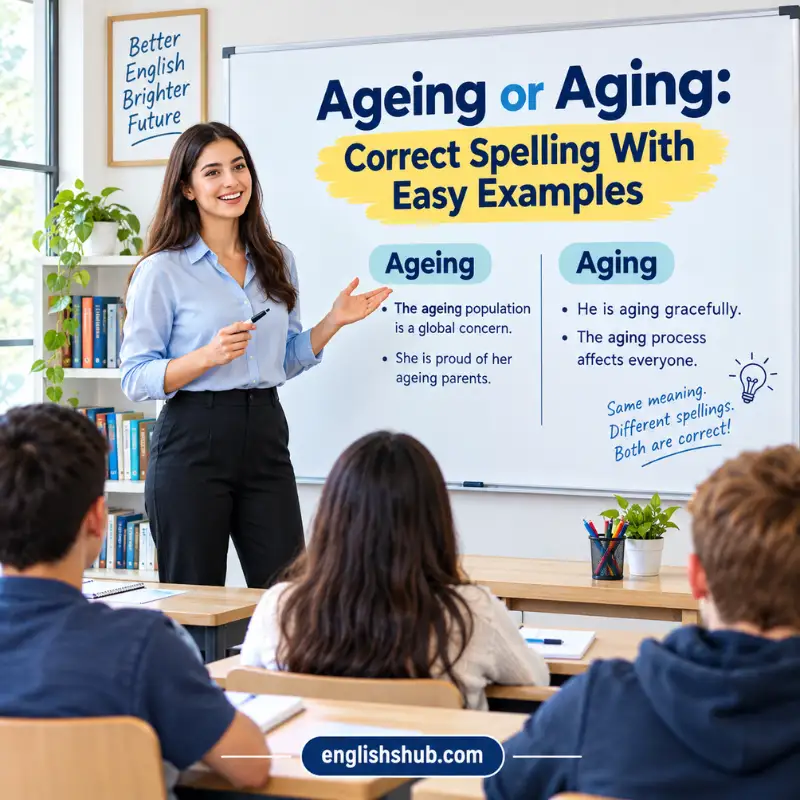
The difference is spelling convention, not definition. Aging drops the final e from age before adding -ing. American English strongly favors this form. In contrast, British English usually keeps the e in this particular word and writes ageing.
Compare these sentences:
- U.S.: The city must replace its aging water pipes.
- U.K.: The city must replace its ageing water pipes.
Both sentences say that the pipes are becoming old or worn. The regional spelling does not change the facts, tone, or grammar.
Merriam-Webster records aging as the present participle of age.
Meanwhile,
Collins lists ageing and also recognizes aging.
These entries support the key point: English has two accepted regional forms.
This pattern resembles other U.S.–British spelling choices. For example, EnglishsHub’s guide to
acknowledgement or acknowledgment
explains another pair in which regional convention affects an extra e.
What Do Aging and Ageing Mean?
Both forms come from the verb age. Depending on the sentence, the -ing form can perform three closely related jobs.
As a verb form
The word can show an ongoing process:
- The wooden deck is aging faster near the ocean.
- Our parents are ageing well. (British style)
In these sentences, is aging and are ageing form part of the verb phrase.
As a participial adjective
The word can modify a noun:
- The county repaired an aging bridge.
- The report examines an ageing population. (British style)
Here, the words describe bridge and population. They tell readers that each noun is getting older.
As a noun or gerund
The word can name a process:
- Aging affects materials as well as living things.
- Healthy ageing remains a public policy goal. (British style)
Traditional school grammar often calls this use a gerund. Some modern grammars use the broader label gerund-participle. Either way, the regional spelling does not change its function.
Why American English Spells It Aging
American aging follows the usual rule for many verbs that end in a silent e: remove the e before adding -ing.
- make → making
- write → writing
- hope → hoping
- age → aging
Therefore, ageing may trigger a U.S. spell-checker. That flag usually means the software is applying an American dictionary, not that the British form is meaningless or globally incorrect.
However, do not turn this pattern into an absolute rule. English keeps the e in some forms to protect pronunciation or prevent confusion. For example, dye becomes dyeing so readers do not confuse it with dying. Likewise, singe commonly becomes singeing to keep the soft g easy to recognize.
The practical lesson is narrow: use aging in ordinary American writing. You do not need a new spelling theory for every verb ending in e.
Why British English Uses Ageing
British English treats ageing as an established spelling convention. The form keeps the e from age, although British writers still drop silent e in ordinary words such as making, writing, and hoping.
That distinction corrects a common oversimplification. It is inaccurate to say that British English generally keeps the final e whenever it adds -ing. Instead, ageing is a recognized word-specific preference.
You may see:
- an ageing society
- the ageing process
- ageing equipment
- healthy ageing
records adjective and noun senses, gives the pronunciation, and identifies aging as an alternative. Therefore, writers can choose the regional form without assigning it a separate meaning.
What About Canada, Australia, and Other Varieties?
English outside the United States and United Kingdom does not follow one universal switch. Australian and New Zealand publications often use British-style ageing. Canadian writing can show both spellings, although many Canadian editors and institutions prefer aging. Irish and international organizations may also follow a chosen house style rather than a reader’s location alone.
As a result, country labels provide a useful starting point, but an organization’s style sheet provides the final answer. If you write for a Canadian university, Australian agency, or global company, check its published pages or editorial guide before choosing.
Do not mix varieties casually. A document that uses colour, centre, and organise will usually look more consistent with ageing. A document that uses color, center, and organize will usually fit aging. A similar audience-based choice appears in
Are Aging and Ageing Pronounced Differently?
No. Both spellings are normally pronounced /ˈeɪdʒɪŋ/, approximately AY-jing. The first syllable rhymes with day, and the second sounds like the ending of changing.
Because the words sound alike, pronunciation cannot tell you which form to write. Audience and house style must guide the spelling instead.
The shared pronunciation also means that neither form creates a speaking error. An American and a British speaker can pronounce the word in the same basic way while spelling it differently. Collins supplies the same pronunciation pattern for its
dictionary treatment of aging and ageing.
Aging and Ageing Examples in Sentences
The following pairs show how the spelling changes while the message remains stable.
People and populations
- U.S.: The clinic supports aging adults who live independently.
- British style: The clinic supports ageing adults who live independently.
The adjective modifies adults in both versions.
- U.S.: The state is preparing for an aging population.
- British style: The country is preparing for an ageing population.
Here, regional choice determines the spelling, not a difference in demographic meaning.
Objects and systems
- U.S.: Engineers inspected the aging rail network.
- British style: Engineers inspected the ageing rail network.
Inanimate things can age, so the word does not apply only to people.
- U.S.: The software platform is aging quickly.
- British style: The software platform is ageing quickly.
Each sentence uses the word as part of an ongoing verb phrase.
Processes
- U.S.: The laboratory studies aging in metals.
- British style: The laboratory studies ageing in metals.
In these examples, the word names a process. The scientific topic stays the same across dialects.
Which Form Fits Formal, Academic, and Business Writing?
Formal writing does not make one spelling universally correct. Instead, the intended variety of English controls the choice.
Use aging in a U.S. resume, college paper, business report, government-facing document, or American website. Use ageing when a British school, publisher, client, or style sheet requires British English.
For academic work, check the journal or university guidelines. A U.S.-based journal may expect aging, while a British publisher may require ageing. International journals often state a spelling policy or accept either variety if the manuscript remains consistent.
Also preserve exact wording in these cases:
- A direct quotation: “The programme promotes healthy ageing.”
- An official title: Centre for Ageing Studies
- A publication or organization name
- A legal or historical document
Changing an official name can create a factual mistake. Likewise, silently altering a direct quotation can misrepresent the source. This principle also applies when choosing between
especially in official business names.
Related Forms and Compounds
The regional choice often continues inside compounds and fixed phrases.
- U.S.: anti-aging cream, age-related change, aging process
- British style: anti-ageing cream, age-related change, ageing process
Many edited styles hyphenate anti-aging or anti-ageing because the prefix joins the whole word. However, dictionaries and brands may use different forms, so preserve an official product name.
The separate compound age-related usually takes a hyphen before a noun:
- The team studies age-related changes.
After the noun, a rewrite often sounds clearer:
- The changes are related to age.
Finally, age out is a phrasal verb. It means to become too old for a program, group, benefit, or role:
- Maya will age out of the youth league next summer.
Its -ing form follows the same regional pattern: aging out in U.S. English and ageing out in British-style English.
Synonyms, Near-Synonyms, and Opposites
No single synonym replaces aging or ageing in every context. Choose an alternative according to what is changing.
| Alternative | Relationship | Best use |
|---|---|---|
| growing older | Close paraphrase | People, animals, and general explanation |
| maturing | Near-synonym | Development toward readiness or fullness |
| weathering | Near-synonym | Materials exposed to time and conditions |
| deteriorating | Negative near-synonym | Declining condition or performance |
| becoming outdated | Contextual paraphrase | Technology, methods, or ideas |
| staying young | Contextual opposite | Appearance, behavior, or condition |
These alternatives carry different tones. Maturing can suggest improvement, while deteriorating suggests damage or loss.
Compare:
- The cheese is aging in a temperature-controlled room.
- The cheese is deteriorating in a temperature-controlled room.
The first sentence can describe a planned process that improves flavor. The second suggests that the cheese is becoming worse. Therefore, the words are not interchangeable even though both involve change over time.
Common Mistakes and Corrections
Calling one form wrong everywhere
Incorrect claim: Ageing is always a misspelling.
Correction: Ageing is standard in British English, while aging is standard in American English.
Mixing both forms without a reason
Inconsistent: The report examines aging equipment and the cost of ageing infrastructure.
Consistent U.S. version: The report examines aging equipment and the cost of aging infrastructure.
A switch can be correct when you preserve a quotation or official name. Otherwise, it distracts readers.
Applying a broad British suffix rule
Incorrect claim: British writers always keep silent e before -ing.
Correction: British writers use making and writing, but they commonly treat ageing as a specific regional form.
Trusting the wrong spell-check setting
A U.S. dictionary may flag ageing, while a British dictionary may prefer it. Therefore, check whether your editor uses English (United States) or English (United Kingdom). The underline reflects that setting; it does not settle every variety of English.
Changing a source’s official spelling
Incorrect: Renaming the “Institute for Healthy Ageing” as the “Institute for Healthy Aging.”
Correction: Keep the verified official spelling, even inside an otherwise American document.
For another spelling pair where context controls the correct form,
see wracking or racking.
How to Choose Between Ageing and Aging
Use this four-step decision rule:
- Identify your main audience. Choose aging for U.S. readers and ageing for British readers.
- Check the required style. A school, client, journal, or employer may specify a variety of English.
- Preserve exact names and quotations. Do not “correct” a legitimate regional form inside source wording.
- Run a consistency check. Search your document for both spellings and review every switch.
A simple memory aid can help: aging goes with America, and ageing keeps the e found at the start of England. The memory aid is not the rule itself, but it points to the usual regional choice.
If no style guide applies and your audience is international, choose one recognized form and remain consistent. When U.S. readers form the main audience, aging is the safest default.
FAQs
Ageing is not a fake word, but it is uncommon in ordinary American writing. Use aging for a U.S. audience unless you are preserving British wording, a quotation, or an official name.
British readers understand aging, and dictionaries may recognize it as a variant. However, ageing remains the safer choice when a document follows a traditional British house style.
Canadian writing can use both forms. Many Canadian publications prefer aging, but the safest choice is to follow the organization’s dictionary or style guide and keep the document consistent.
Use anti-aging in American English and anti-ageing in British-style English. Preserve the registered or official spelling when referring to a particular product, campaign, or organization.
No. Both can refer to people growing older, materials becoming worn, food developing over time, or systems losing efficiency. Their regional spelling differs, but their grammatical roles and core meanings match.
Your software probably uses a U.S. English dictionary. Change the proofing language to British English if that matches your document, or keep aging when writing for American readers.
Test Your Understanding
- Which sentence best fits standard American English?
A. The city is replacing its ageing buses.
B. The city is replacing its aging buses.
C. The city is replacing its ageging buses.
D. The city is replacing its ageding buses.
- Which statement is accurate?
A. The two spellings have different pronunciations.
B. Ageing can describe people but not objects.
C. Aging is informal, while ageing is formal.
D. Both spellings can function as verb forms, adjectives, or nouns.
- Which sentence correctly preserves an official British name?
A. The U.S. report cited the Centre for Healthy Ageing.
B. The U.S. report renamed it the Center for Healthy Aging without checking.
C. Every proper name must use American spelling.
D. Quotations should always be respelled silently.
- Which explanation of the suffix rule is most accurate?
A. British English always keeps silent e before -ing.
B. American English never drops silent e.
C. American aging follows the usual drop-e pattern, while British ageing is an established regional form.
D. Ageing and aging come from different verbs.
- Which compound best fits an American product description?
A. anti-ageing serum
B. anti-aged serum
C. anti-age seruming
D. anti-aging serum
Answer Key
- B. American English normally uses aging without the extra e.
- D. The regional spelling changes, but the available grammatical functions remain the same.
- A. Writers should preserve the verified spelling of an official name, even in an American document.
- C. This answer states the normal American pattern without inventing a universal British suffix rule.
- D. Anti-aging is the standard regional form for general American copy.
Conclusion
Both forms in ageing or aging are legitimate English spellings. For American readers, choose aging. For British-style writing, ageing is usually the better fit. The words share a pronunciation, meaning, and set of grammatical roles, so audience and editorial style—not meaning—decide the spelling. After choosing, use the same form throughout your document, except when an exact quotation or official name requires the other version.
Related Grammar and Language Guides
Acknowledgement or Acknowledgment: Which Is Correct?
Aesthetic or Esthetic: Correct Spelling and Clear Guide
Afterward or Afterwards: Which Is Correct in US English?


[…] ageing or aging. […]
[…] ageing or aging, […]
[…] Ageing or Aging guide […]
[…] Ageing or Aging: Correct Spelling With Easy Examples […]