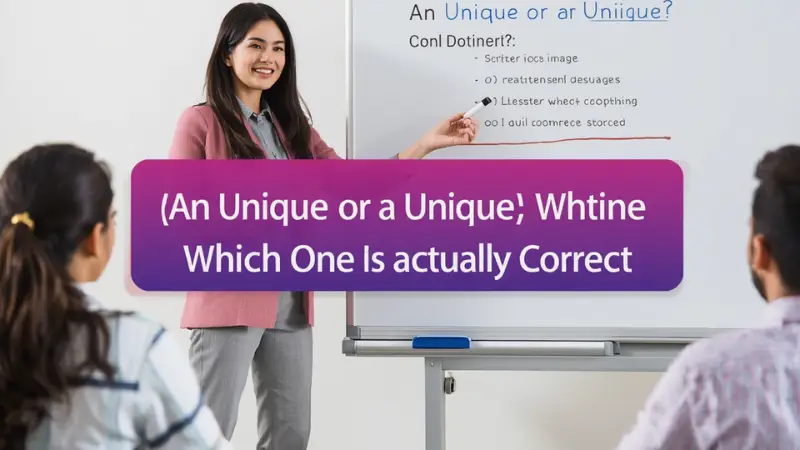
Many writers pause before the word “unique,” unsure whether to write an unique or a unique. The confusion is understandable, but the answer is simple once you know the rule that governs it. This article settles the question and explains exactly why one version is correct in every context.
Quick Answer
“A unique” is correct, and “an unique” is a common error. English chooses “a” or “an” based on the sound that follows, not the letter. Although “unique” starts with a vowel letter, it starts with a consonant sound, /j/, like the “y” in “yes.” Because of that sound, “a unique” is the only grammatically accurate choice in both American and British English.
TL;DR
- Use “a unique,” never “an unique,” in all standard English writing.
- Article choice depends on sound, not spelling.
- “Unique” begins with a /j/ sound, so it behaves like a consonant.
- Similar words include “a university,” “a European,” and “a one-time offer.”
- This rule applies consistently in the United States and the United Kingdom.
- “An unique” is a frequent mistake, not an acceptable variant.
Why “A” Comes Before “Unique”
English speakers often assume that words starting with A, E, I, O, or U automatically take “an.” That assumption works most of the time, but it breaks down whenever a vowel letter produces a consonant sound. “Unique” is one of the clearest examples of this pattern.
Say the word aloud. It begins with a “yoo” sound, not an “uh” sound. Linguists classify this as a glide consonant, similar to the sound at the start of “yellow” or “yard.” Because English article selection tracks pronunciation, the word needs “a,” matching how it actually sounds rather than how it is spelled.
This is why “a unique” feels natural to fluent speakers, even before they can explain the underlying rule. Native speakers rarely say “an unique” out loud, since the ear naturally rejects it.
The Real Rule Behind “A” and “An”

The choice between “a” and “an” always depends on the initial sound of the next word, not its first letter. This distinction explains several exceptions that confuse learners of English.
Consider “an hour.” The word starts with a silent “h,” so the sound that follows is a vowel, making “an” correct. Compare that with “a house,” where the “h” is pronounced, producing a consonant sound and requiring “a.”
The same logic applies in reverse to words starting with vowel letters that produce consonant sounds. “University,” “European,” “one-eyed,” and “unique” all begin with a /j/ or /w/ glide, so each one takes “a” instead of “an.”
Common Words That Follow the Same Pattern
Recognizing this pattern makes it easier to avoid similar mistakes elsewhere in your writing. Several everyday words behave exactly like “unique.”
- A university — pronounced “yoo-ni-VER-si-ty”
- A European — pronounced “yur-o-PEE-an”
- A user — pronounced “YOO-zer”
- A one-way street — pronounced “WUN-way”
- A unicorn — pronounced “YOO-ni-corn”
Each example starts with a vowel letter but a consonant sound, so “a” is required. Once you see the pattern across multiple words, “a unique” stops feeling like an exception and starts feeling like part of a consistent system.
Why “An Unique” Still Appears So Often
If the rule is clear, why do so many people still write “an unique”? The mistake usually comes from a simplified version of the rule learned in early education: vowels take “an,” consonants take “a.”
That shortcut works for the majority of English words, so it becomes an automatic habit. However, it fails whenever pronunciation and spelling diverge, as they do with “unique.” Writers relying on memory rather than sound are the ones most likely to produce “an unique” by mistake.
Autocorrect tools and spell checkers do not always catch this error, since both “a” and “an” are valid words on their own. As a result, the mistake can slip through drafts, emails, and even published content without triggering an obvious flag.
United States and United Kingdom Usage
United States:
American English follows the sound-based rule exactly as described here. “A unique” is standard in formal writing, academic papers, and everyday speech across the US.
United Kingdom:
British English applies the identical rule. Style guides, including those used by major UK publishers and universities, confirm that “a unique” is correct and “an unique” is considered a grammatical error.
There is no regional variation on this point. Both major English dialects treat “unique” as a consonant-sound word for the purposes of article selection.
Learn why “a unique” is correct in Merriam-Webster’s guide:
https://www.merriam-webster.com/grammar/is-it-a-or-an
How to Remember the Rule Permanently
Instead of memorizing exceptions, focus on sound rather than spelling whenever you feel unsure. Before choosing “a” or “an,” say the following word aloud in your head.
If it starts with a clear consonant sound, such as /j/, /w/, or a pronounced “h,” use “a.” If it starts with an open vowel sound, use “an.” This simple test resolves “unique” and dozens of similar tricky words without requiring a memorized list.
Over time, this habit becomes automatic, and phrases like “a unique opportunity” or “a unique perspective” will feel just as natural as “an apple” or “an idea.”
FAQs
No. Style guides in both the US and UK treat “a unique” as the only correct form. “An unique” is considered a grammatical error in academic, business, and published writing.
No. The rule depends on the word immediately following “a” or “an,” so phrases like “a unique idea” or “a truly unique design” still use “a,” since “unique” or “truly” both begin with consonant sounds.
Yes. “University,” “European,” “one-time,” and “user-friendly” follow the same pattern, since each starts with a vowel letter but a consonant sound.
“Hour” has a silent “h,” so the word begins with a vowel sound. “Unique” begins with a /j/ consonant sound despite its spelling, so it needs “a” instead.
Conclusion
The debate over an unique or a unique has a clear, consistent answer: always use “a unique.” The decision comes down to sound, not spelling, and that single principle explains every exception you will encounter with English articles. Once you apply the sound test consistently, this mistake becomes easy to avoid for good.