

Choosing between bad rap or bad rep is easier once you separate tradition from literal meaning. Bad rap is the original, established idiom for negative judgment, blame, or an unfavorable reputation, often considered unfair. Therefore, it is the safest choice in polished American English.
However, bad rep is not meaningless. “Rep” is informal shorthand for “reputation,” so the expression can literally mean “bad reputation.” It appears in casual speech and writing, although many editors still prefer “bad rap.”
Quick Answer
Bad rap is the standard idiom and the best choice in formal, academic, business, and edited writing. It usually refers to unfavorable blame or a negative reputation, especially one viewed as unfair. Bad rep is understandable informal shorthand for “bad reputation,” while bad wrap is wrong unless you mean a poorly made sandwich or covering.
Key Takeaways
- Choose “bad rap” for the established English idiom.
- Use “bad rep” only when an informal tone fits.
- Never assume the two forms mark fairness absolutely.
- Reserve “bad wrap” for an actual covering or food.
- Match the expression to your audience and intended meaning.
Bad Rap, Bad Rep, and Bad Wrap at a Glance
| Form | Basic Meaning | Status | Best Use |
|---|---|---|---|
| Bad rap | Negative judgment, blame, or reputation | Established idiom | Most speech and polished writing |
| Bad rep | Bad reputation | Informal abbreviation | Casual conversation or dialogue |
| Bad wrap | A poor covering or rolled food item | Literal phrase, not the idiom | Food, packaging, or clothing |
| Bum rap | Unfair charge or treatment | Established informal expression | Conversational writing |
| Good rep | Good reputation | Natural informal abbreviation | Casual and business conversation |
Is Bad Rap or Bad Rep Correct?
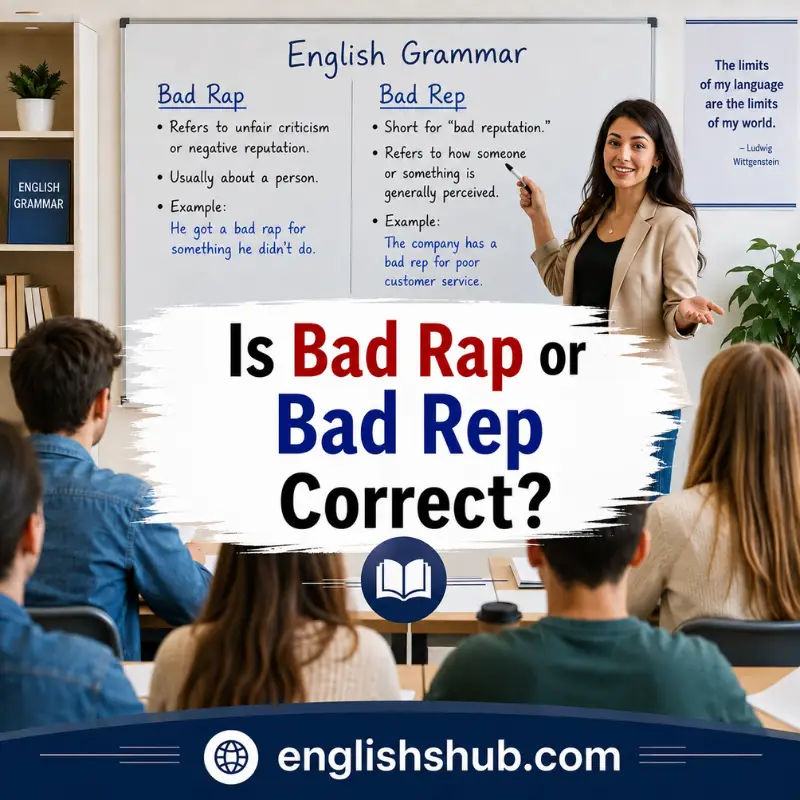
Both forms can communicate a real idea, but they do not have equal standing. Bad rap is the traditional idiom. As a result, editors and teachers usually recommend it when someone receives blame, criticism, or a poor reputation.
“Bad rep” is a transparent shortening of “bad reputation.” Modern readers can understand it without difficulty. In fact,
Merriam-Webster’s usage discussion
notes that the variant has gained enough usage to merit recognition. That evidence matters because it shows why calling every instance a misspelling is too rigid.
Still, recognition does not make the forms equally suitable everywhere. Use bad rap when you need the conventional expression. Save bad rep for a deliberately informal voice.
What Does Bad Rap Mean?
A bad rap is an unfavorable charge, judgment, or reputation. It often suggests unfair criticism or undeserved blame, but context determines how strongly that implication applies.
For example, “Frozen vegetables get a bad rap” suggests that people judge them too harshly. Meanwhile, “The manager has a bad rap for missing deadlines” reports an unfavorable reputation. It may imply unfairness, but the sentence alone does not prove that the judgment lacks evidence.
The expression functions as a noun phrase. “Bad” modifies “rap,” while “rap” carries an older sense connected with criticism, accusation, or adverse consequences.
The Collins Dictionary entry for “bad rap”
classifies it as informal American English and connects it with “bum rap.” This classification explains why the phrase can sound conversational while remaining standard and recognizable.
When Bad Rep Works in Informal English
“Bad rep” works when the writer intentionally shortens “bad reputation.” It sounds most natural in conversation, dialogue, social posts, notes, and relaxed workplace messages.
Consider this exchange:
“Why doesn’t anyone hire that contractor?”
“He has a bad rep around town.”
The answer sounds natural because the speaker uses casual language. However, an investigative report might choose “The contractor has developed a poor reputation” for greater precision. An edited magazine article could also use “bad rap” if it meant public criticism rather than merely a general reputation.
Therefore, do not treat “bad rep” as an automatic error. Instead, ask whether its clipped tone suits the context. If a teacher, client, editor, or broad audience will read the sentence, bad rap or poor reputation is usually safer.
Where the Bad Rap Idiom Came From
The history of “rap” explains why the established spelling uses an a. The word first referred to a sharp knock or blow. Later, English speakers extended it to punishment, rebuke, responsibility, criminal charges, and adverse judgment.
The Online Etymology Dictionary’s entry for “rap”
traces the senses involving blame and responsibility to the eighteenth century. It also records later criminal uses, including expressions connected with charges. This history matters because the idiom developed from established meanings of “rap,” not from modern rap music.
Related expressions preserve the same semantic family. Someone may take the rap by accepting responsibility. A defendant may beat the rap by avoiding conviction. Likewise, a rap sheet records arrests or alleged offenses, although the everyday phrase now extends far beyond criminal contexts.
Why Bad Wrap Is Usually a Mistake
“Bad wrap” is not the reputation idiom. “Wrap” refers to a covering, an act of wrapping, or food rolled in flatbread. Therefore, it fits sentences about packaging, clothing, gifts, or sandwiches.
A person might write:
- The gift had a bad wrap because the paper tore.
- The café served a bad wrap with cold filling.
However, “The neighborhood gets a bad wrap” uses the wrong word. The error occurs because “rap” and “wrap” sound alike. Linguists may describe this kind of reshaping as an eggcorn when a speaker replaces an unfamiliar expression with more familiar words that seem logical. It resembles a mondegreen, although that term more often describes misheard lyrics or spoken lines.
How Grammar and Verb Choice Affect the Phrase
“Bad rap” usually follows verbs such as get, receive, have, give, or earn. The verb can slightly change the sentence’s emphasis.
- Get a bad rap emphasizes receiving negative judgment.
- Give someone a bad rap emphasizes causing that judgment.
- Have a bad rap describes an existing reputation.
- Earn a bad rap suggests conduct contributed to the result.
- Receive a bad rap sounds more formal than “get.”
The phrase does not need a hyphen in normal use. Write “The policy got a bad rap,” not “a bad-rap.” However, if a publication used it before another noun as a compound modifier, its style guide might call for different treatment. Rewriting usually sounds clearer than creating an awkward compound.
Choosing the Right Form for Your Audience
Audience and tone should guide the final choice. In edited prose, bad rap prevents readers from pausing over the wording. It is therefore the strongest default for school assignments, news articles, professional blogs, and business documents.
| Context | Recommended Wording | Reason |
|---|---|---|
| Academic assignment | bad rap or poor reputation | Conventional and clear |
| Business report | poor reputation | More precise and professional |
| News or feature article | bad rap | Familiar established idiom |
| Casual conversation | bad rap or bad rep | Either may sound natural |
| Fictional dialogue | Match the speaker’s voice | Informality may be intentional |
| Legal document | specific charge or allegation | The idiom may lack precision |
In legal, disciplinary, or high-stakes writing, name the exact allegation or consequence. “Bad rap” can blur the difference between criticism, reputation, accusation, and formal liability.
Correct and Incorrect Sentence Examples
The following examples show both spelling and meaning:
- Correct: Brussels sprouts get a bad rap because many people remember overcooked versions.
The idiom describes a broadly negative judgment. - Correct but informal: That gaming community has a bad rep online.
Here, “rep” clearly shortens “reputation.” - Better for edited prose: The neighborhood gets a bad rap, although crime has declined.
The contrast supports the idea of an unfair judgment. - Incorrect idiom: Remote workers often get a bad wrap.
Correction: Remote workers often get a bad rap. - More precise: The supplier developed a poor reputation after repeated delays.
This wording works better than an idiom in a formal report. - Correct: She took the rap for a decision the whole team approved.
This related expression means she accepted the blame.
These examples also show why fairness is not a perfect spelling test. Context, evidence, and tone still shape the meaning.
A Three-Question Editing Test
Use this quick framework whenever the forms compete:
- Do I mean blame, criticism, or an unfavorable public judgment?
Choose bad rap, especially if the judgment seems unfair. - Am I deliberately abbreviating “reputation” in casual language?
Bad rep can work, but confirm that the informal tone suits your audience. - Would “poor reputation” communicate the idea more precisely?
Use the full wording in reports, formal emails, academic work, or sensitive claims.
If you remain unsure, select bad rap. It is the recognized idiom and the least distracting option in standard English. However, precision should outrank idiomatic color when the reason for the negative reputation matters.
Related Expressions That Are Easy to Confuse
Bum rap means an unfair charge, punishment, or reputation. It strongly emphasizes that the treatment is undeserved. Therefore, it can replace “bad rap” in some informal sentences.
Take the rap means to accept blame or punishment. It does not necessarily describe a long-term reputation. Meanwhile, beat the rap refers to escaping a charge or punishment, often in a legal or crime-related context.
Finally, good rep is natural shorthand for “good reputation.” “Good rap” is possible in literal or specialized contexts, including music, but it is not the usual opposite of the reputation idiom. English usage is not always symmetrical, so writers should learn each expression as it is actually used.
FAQs
No. The expression often carries that implication, especially when a speaker defends someone or something. However, dictionaries also record broader senses involving a negative charge or reputation. Surrounding details reveal whether the speaker believes the judgment is unfair.
No, “bad rep” can be grammatical shorthand for “bad reputation.” Nevertheless, it remains informal and may look like an error to readers who expect the established idiom. Use “bad rap” or “poor reputation” in careful prose.
Both are correct. “Get a bad rap” focuses on acquiring negative judgment, while “have a bad rap” describes an existing public image. For example, a new rule may get a bad rap and continue to have one for years.
Yes. A company, product, industry, neighborhood, policy, food, or activity can have a bad rap. The subject does not need to be a person. The phrase simply signals negative public judgment or reputation.
A bad reputation is a broad negative public opinion that may be deserved or undeserved. A bad rap is an idiomatic expression that often highlights criticism or blame, especially when the speaker believes people have judged the subject too harshly.
“Bad rap” is acceptable in much edited writing, but it remains informal. In academic, legal, or highly technical material, “unfavorable reputation,” “unsupported allegation,” or “negative public perception” may communicate the exact idea more clearly.
Conclusion
When choosing between bad rap or bad rep, use bad rap as the safest established expression. It works for negative judgment, blame, or reputation and often suggests that the treatment is unfair. “Bad rep” remains understandable as informal shorthand for “bad reputation,” so it is not automatically meaningless or ungrammatical.
For polished writing, choose “bad rap” or state “poor reputation” directly. Also avoid “bad wrap” unless the subject truly involves food, packaging, or another kind of covering.