
Choosing sheers or shears depends on what your sentence describes. Shears names cutting tools, while sheers can name thin, partly transparent curtains. A stylist reaches for shears, but a decorator hangs sheers. Both spellings are real words, so replacing every instance of one with the other would create new mistakes.
The distinction also reaches beyond objects. A person shears wool, while a boat sheers away from its course. In those sentences, the words express actions. Their shared pronunciation explains the confusion, but meaning and grammar resolve it. When you identify what the word names or does, you can choose the spelling without guessing from sound.
Quick Answer
Use shears for cutting tools and sheers for thin curtain panels. Both can also be verbs: a machine shears metal, while a vessel sheers away, meaning it turns aside. When choosing sheers or shears, check the intended meaning. Neither spelling replaces the other in every context, and specialized uses require a closer look.
TL;DR
- Garden, kitchen, and hair cutting tools take the spelling shears.
- In sheer curtains, the adjective stays unchanged before a plural noun.
- Write these shears are, but this pair of shears is.
- Sheared describes cutting or severing; sheered describes turning aside.
- Both spellings belong to standard English; this is not an American versus British spelling choice.
Sheers and Shears at a Glance
| Situation | Correct form | Word’s job | Example |
|---|---|---|---|
| Naming a cutting tool | shears | Plural noun | The shears need sharpening. |
| Naming thin curtain panels | sheers | Plural noun | Pale sheers cover the windows. |
| Describing cutting | shears | Present-tense verb | The machine shears each sheet. |
| Describing a change of course | sheers | Present-tense verb | The dinghy sheers toward shore. |
| Describing thin fabric | sheer | Adjective | She chose sheer sleeves. |
| Naming one cutting instrument | a pair of shears | Singular noun phrase | A pair of shears lies nearby. |
What Does Shears Mean?
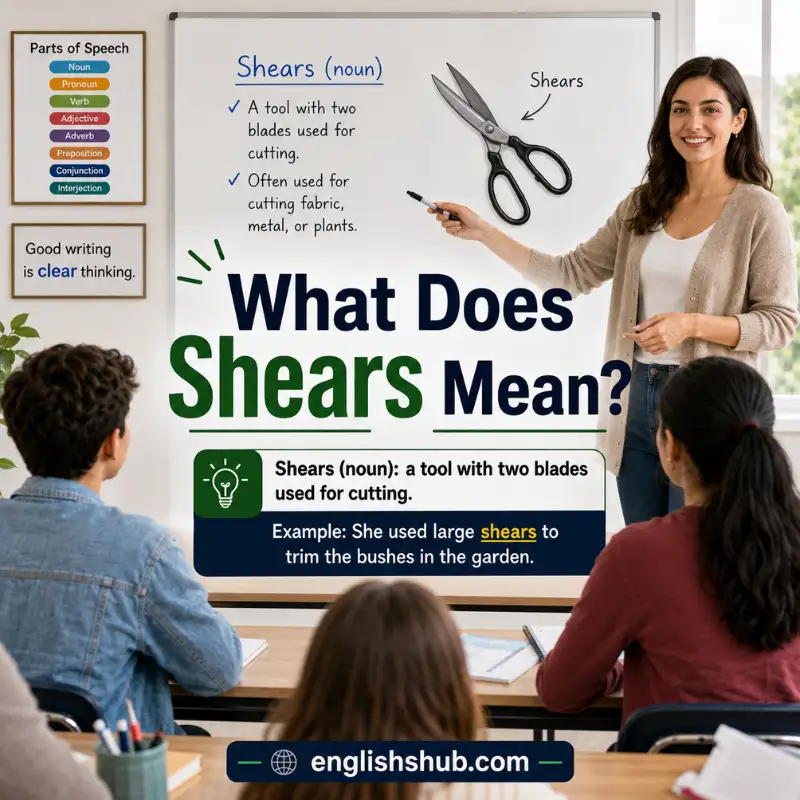
Shears are cutting tools, often large scissors or tools designed for a particular cutting task.
The Collins definition of shears
includes ordinary cutting implements and larger machines with opposing cutting edges.
The word before shears often identifies the task or setting:
- Garden shears: “Luis left the garden shears beside the empty pots.”
- Kitchen shears: “Nina used kitchen shears to snip the twine.”
- Hair shears: “The stylist placed her hair shears on a clean towel.”
- Fabric shears: “Keep the fabric shears in the sewing drawer.”
In each example, shears names an object. Therefore, the spelling stays the same even though the material and purpose change.
However, shears does not mean every possible cutting tool. A knife is a cutting tool, but calling it shears would misidentify it. The word refers to particular implements, not simply anything sharp.
For a sentence about gardening or hair cutting, garden sheers and hair sheers are spelling errors. Their intended meaning requires shears.
What Does Sheers Mean?
Sheers can mean articles made from thin, transparent fabric, especially curtain panels. Merriam-Webster records both the fabric and an article made from it under the
For example, “We washed the bedroom sheers on Saturday” refers to curtains. Nothing in that sentence involves a cutting instrument.
Compare these two forms:
- “Amira ordered sheer curtains for the studio.”
- “Amira ordered sheers for the studio.”
In the first sentence, sheer describes the noun curtains. In the second, sheers names the curtain panels directly. As a result, sheers curtains is not the normal wording for this meaning. Use sheer curtains or simply sheers.
The distinction remains useful when both words appear together:
“The tailor used shears to shorten the sheers.”
Here, shears identifies the tool, while sheers identifies the fabric articles. The sentence works because the two spellings do different jobs.
Why Do Sheers and Shears Sound Alike?
Sheers and shears are homophones, words with the same pronunciation but different meanings or spellings. In standard American English, both sound approximately like “sheerz” and rhyme with cheers. That respelling is a pronunciation aid, not another accepted spelling.
The final sound is a voiced z, rather than the s sound in cats. However, pronunciation cannot reveal whether a speaker means curtains, cutting tools, or an action. You need the surrounding words.
For instance, sharpen the ___ points toward a tool, while hang the ___ at the window points toward curtain panels.
The same listening problem occurs with fourth and forth. A spoken word alone may leave the spelling unclear, but its role in a sentence supplies the clue.
Is It “These Shears Are” or “This Pair Is”?
For an ordinary cutting instrument, use these shears are and this pair of shears is. Although one instrument has two blades, shears normally takes plural agreement.
- “These shears are rusty.”
- “My shears have blue handles.”
- “This pair of shears is rusty.”
- “Two pairs of shears are missing.”
In the third example, the main noun is pair. Because pair is singular, it takes is. In the fourth, pairs is plural, so are fits.
For everyday writing, choose “I bought a pair of shears” when you want to count one instrument. This avoids awkward wording such as “I bought a shears.”
Curtain sheers also take plural agreement: “The sheers are dry.” However, the adjective does not control the verb in “The sheer curtain is dry.” The singular noun curtain does.
These patterns concern grammar, not how many separate objects you can see.
How Shears and Sheers Work as Verbs
Both words can describe actions in the present tense. With he, she, it, or another singular subject, the base verbs become shears and sheers.
- “The technician shears a narrow strip from the sheet.”
- “The small ferry sheers away from the landing.”
The first action involves cutting. The second involves changing course. In contrast, plural subjects take the base form: “The technicians shear the sheets.”
Useful verb forms include:
| Base verb | He, she, or it | Simple past | After have or has | -ing form |
|---|---|---|---|---|
| shear | shears | sheared | sheared or shorn | shearing |
| sheer | sheers | sheered | sheered | sheering |
Merriam-Webster lists sheared, shorn, and shearing in its
For example, “The crew has shorn the sheep” uses a past participle after has.
Also compare “The bolt shears off” with “The canoe sheers off course.” The bolt breaks; the canoe turns. A direct object is not required in either sentence.
Other word pairs also require attention to both meaning and form, as the guide to
demonstrates.
Sheer and Shear in Other Common Phrases
The adjective sheer has several meanings beyond thin fabric. It can describe something almost vertical or emphasize the completeness or extent of something.
separates these senses.
- “A sheer cliff rises behind the cabin.” Here, sheer means extremely steep.
- “Finding the missing ticket was sheer luck.” Here, it emphasizes pure chance.
- “The sheer number of boxes surprised us.” Here, it emphasizes the quantity itself.
These adjectives remain sheer, even before plural nouns: sheer walls, not sheers walls.
There is also a useful technical contrast:
- Shear force refers to a force acting parallel to a surface or cross-section.
- Sheer force emphasizes force itself or its overwhelming amount.
Thus, “The engineer calculated the shear force” and “The door opened through sheer force” mean different things. The technical term shows why “use sheer whenever nothing is being cut” is too broad a rule.
Synonyms and Opposites in Context
Alternatives work only when they preserve the intended sense. Neither sheers nor shears has one synonym that fits every sentence.
| Intended meaning | Useful alternative | Limit to remember |
|---|---|---|
| Shears as a tool | scissors | The names overlap, but specialized tools may need their specific name. |
| Sheers at a window | sheer curtains | Curtains alone leaves out the thin-fabric detail. |
| Shears as an action | cuts, clips, trims | Cuts is broader; trims often suggests removing a smaller amount. |
| Sheers as an action | swerves, veers, turns aside | These describe movement, not severing. |
| Sheer as an emphasis word | pure, utter, complete | The best substitute depends on the following noun. |
For example, “She trimmed the ends of his hair” does not necessarily describe the close cutting suggested by “She sheared his hair.” Likewise, pure luck can replace sheer luck, but transparent luck cannot.
For fabric, opaque provides an opposite to sheer. For a slope, gentle offers a contextual contrast to sheer. However, neither word is an antonym of the cutting tool shears.
Both main spellings are neutral in their normal settings. For a general audience, turns aside may make a movement description clearer than the less familiar verb sheers.
Common Sheers or Shears Mistakes
To choose sheers or shears, identify the intended meaning. Each revision below repairs a different problem.
| Incorrect for the stated meaning | Correct | Why |
|---|---|---|
| I sharpened the sewing sheers. | I sharpened the sewing shears. | Sharpening points to a cutting tool. |
| The white shears filter the daylight. | The white sheers filter the daylight. | The sentence means fabric panels. |
| We chose sheers curtains. | We chose sheer curtains. | An adjective does not gain a plural ending here. |
| This pair of shears are heavy. | This pair of shears is heavy. | The singular noun pair controls agreement. |
| The pin sheered off under strain. | The pin sheared off under strain. | Breaking under strain takes shear. |
Because both spellings exist, a basic spelling check may not settle the choice. Read the full sentence and ask what happened or which object it names.
For another example of how meaning determines the spelling of a fixed phrase, compare
A Three-Step Check for Sheers or Shears
Use this short check when proofreading:
- Identify the job. Does the word name an object, describe one, or express an action?
- Identify the meaning. Cutting tools and cutting actions point to shears. Thin curtain panels and turning actions point to sheers.
- Check the form. Use sheer as the adjective, match the verb to the subject, and review specialist terms separately.
Apply it to “Maya packed the ___ for her sewing class.” The blank names an object, and the sewing context points to a tool. Therefore, shears fits.
Now consider “The launch ___ to the right.” If the intended action is a turn, choose sheers. A boat setting alone does not determine the spelling; the action does.
This meaning-based approach also helps with
where listening cannot distinguish the two spellings.
FAQs
Hair shears is the correct phrase for the cutting tools. A salon sentence such as “Please clean the hair shears” needs shears, even if the writer has seen sheers used for curtains elsewhere.
Yes. The noun sheer can name an article made from sheer fabric. However, one sheer panel or one sheer curtain makes the meaning clearer when your reader does not already know the context.
No. In ordinary use, a pair of shears names one complete cutting instrument. If you mean two instruments, write two pairs of shears. Compare “one pair is missing” with “two pairs are missing.”
No. British and American English both use shears for cutting tools. The difference between sheers and shears concerns meaning and grammatical use. Changing your intended audience does not turn garden sheers into the standard tool name.
Yes. Collins records sheers as an alternative name for a specialized hoisting framework in its shear entry, sense 16. This exception does not make kitchen sheers correct. The seel or seal guide likewise distinguishes an unusual valid word from an everyday spelling error.
Only if the sentence means cutting, severing, or breaking under shear stress. Keep sheered when it means turning aside. For example, “The yacht sheered toward the channel” describes movement, so that spelling is appropriate.
Test Your Understanding
1. Which word names the cutting tool in this sentence? “Please put the kitchen ___ in the drawer.”
- A. sheers
- B. shears
- C. sheered
- D. sheer
2. Which sentence correctly names thin window coverings?
- A. We hung white shears in the den.
- B. We hung white sheared in the den.
- C. We hung white sheering in the den.
- D. We hung white sheers in the den.
3. Which sentence has standard agreement for one cutting instrument?
- A. This pair of shears is new.
- B. These shears is new.
- C. This pair of shears are new.
- D. These pair of shears is new.
4. Choose the verbs meaning “breaks off” and “turns aside”: “The pin ___ off; the boat ___ away.”
- A. sheers; shears
- B. shears; shears
- C. shears; sheers
- D. sheers; sheers
5. Which form completes the sentence about removing wool? “The workers have ___ the sheep.”
- A. sheered
- B. shorn
- C. shearing
- D. shears
Answer Key
- B — shears. The blank names a cutting instrument.
- D — We hung white sheers in the den. Sheers names the thin curtain panels.
- A — This pair of shears is new. The singular noun pair takes is.
- C — shears; sheers. The pin breaks, while the boat changes course.
- B — shorn. Shorn is a past participle of shear and fits after have.
Conclusion
The choice between sheers or shears becomes clearer when you separate the object from the action. Name cutting instruments with shears and thin curtain panels with sheers. For verbs, check whether something cuts or breaks, or instead turns aside. Finally, remember that sheer curtains uses an adjective, while a pair of shears takes a singular verb. Read for meaning first, then check the form.
Related Grammar and Language Guides
Fourth or Forth: Simple Difference and Clear Examples
Herd or Heard: Simple Difference and Clear Examples
Legal Counsel or Council: Meaning, Difference, and Correct Usage