
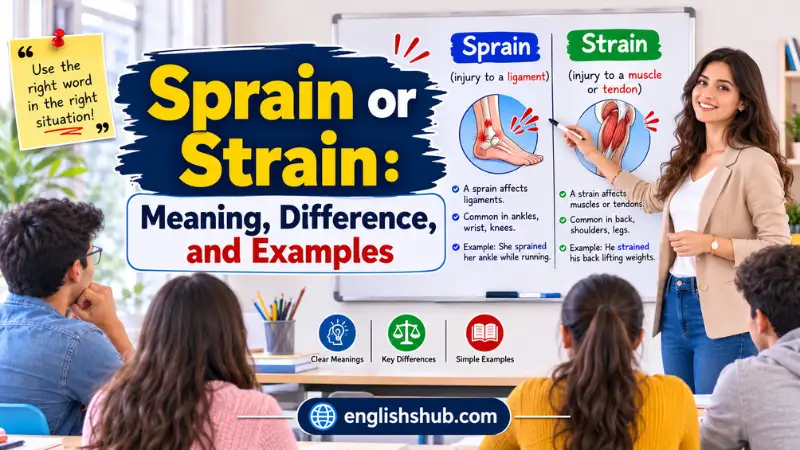
If you are unsure whether to use sprain or strain, the key difference is simple: a sprain involves a ligament, while a strain involves a muscle or tendon. Both words can describe physical injuries, so they are easy to confuse. However, they are not interchangeable in their main physical meanings.
There is another important difference, too. Strain has several broader meanings in English. It can describe pressure, stress, effort, or a particular quality or type of something. Sprain is much more specific.
Understanding these differences will help you choose the right word in both everyday conversation and writing.
Quick Answer
Use sprain for an injury involving a ligament, such as a sprained ankle. Use strain for an injury involving a muscle or tendon, such as a strained muscle. The words are related because both can describe physical injuries, but they refer to different tissues. Also, strain has several non-medical meanings that sprain does not.
TL;DR
- Sprain usually refers to an injury involving a ligament.
- Strain can refer to an injury involving a muscle or tendon.
- A person can sprain an ankle or strain a muscle.
- Strain has many other meanings, including pressure, stress, and effort.
- Sprain is much more limited in meaning.
- Both words can function as nouns and verbs.
Sprain or Strain: Quick Comparison
| Word | Main physical meaning | Common example | Other common meanings |
|---|---|---|---|
| Sprain | Injury involving a ligament | She sprained her ankle. | Very limited compared with strain |
| Strain | Injury involving a muscle or tendon | He strained his back. | Stress, pressure, effort, type, or variety |
| Sprained | Past form/adjective | She has a sprained wrist. | — |
| Strained | Past form/adjective | He has a strained muscle. | Tense, forced, or under pressure |
The easiest rule is ligament = sprain; muscle or tendon = strain when you are talking about physical injuries.
What Does Sprain Mean?

Sprain is a noun and a verb. In its most common physical sense, it refers to an injury involving a ligament.
A ligament is a strong band of tissue that connects bones at a joint. Therefore, English speakers commonly use sprain with joints and the ligaments around them.
For example:
- She sprained her ankle during the game.
- He has a sprained wrist.
- The player suffered a sprain during practice.
- I think I sprained my ankle.
The word also changes form depending on grammar:
- sprain — base form
- sprains — third-person singular or plural noun
- sprained — past tense and past participle
- spraining — present participle
For example, “She sprained her ankle” uses sprained as the past-tense verb.
What Does Strain Mean?
Strain is also both a noun and a verb. When it refers to a physical injury, it commonly involves a muscle or tendon.
For example:
- He strained a muscle while exercising.
- She has a strained tendon.
- The athlete suffered a muscle strain.
- I strained my back while lifting a box.
However, strain has a much wider range of meanings than sprain.
It can describe pressure or stress:
- The long hours put a strain on their relationship.
- The extra expense created financial strain.
- Working without enough rest can place strain on the body.
It can also refer to a particular type, variety, or line of something:
- Scientists studied a new strain of bacteria.
- The poem contains a humorous strain of thought.
Because strain has several meanings, context matters.
Sprain or Strain: What Is the Difference?
The main difference is the part of the body or tissue being described.
A sprain affects a ligament. A strain affects a muscle or tendon.
Consider these examples:
She sprained her ankle.
This means the injury involves a ligament around the ankle.
She strained a muscle in her leg.
This means the injury involves muscle tissue.
The two words can therefore appear in similar sentences, but replacing one with the other changes the intended meaning.
Compare:
- He sprained his ankle. ✓
- He strained his ankle. △
The second sentence may be understood in some contexts, but it does not communicate the usual ligament-injury meaning as clearly.
Now compare:
- She strained her hamstring. ✓
- She sprained her hamstring. ✗
A hamstring is a group of muscles, so strain is the natural choice for this physical meaning.
How to Choose Sprain or Strain in a Sentence
Use this simple decision rule:
Is the physical injury being described as a ligament injury? Use sprain. Is it a muscle or tendon injury? Use strain.
For example:
- ankle ligament → sprain
- wrist ligament → sprain
- muscle → strain
- tendon → strain
The words often occur with different collocations, which makes them easier to recognize.
Common combinations include:
Sprain
- sprained ankle
- sprained wrist
- ankle sprain
- wrist sprain
Strain
- muscle strain
- strained muscle
- strained tendon
- back strain
Learning these common combinations can be more useful than memorizing the definitions alone.
Sprain and Strain as Verbs
Both sprain and strain can function as verbs.
With sprain, the object is often a body part or joint:
- I sprained my ankle.
- She sprained her wrist.
- He sprained his knee.
With strain, the object can be a muscle, tendon, or another part of the body:
- She strained her back.
- He strained a muscle.
- The runner strained his hamstring.
Notice that the past form of both verbs ends in -ed:
- sprain → sprained
- strain → strained
This means pronunciation and spelling can sometimes make the words seem even more similar.
They are still different words with different meanings.
Examples of Sprain and Strain
Here are paired examples that show the difference clearly.
Example 1
She sprained her ankle while playing soccer.
Use sprained because the sentence refers to a ligament injury.
Example 2
He strained a muscle while lifting the box.
Use strained because the sentence refers to a muscle injury.
Example 3
The doctor diagnosed an ankle sprain.
Here, sprain is a noun.
Example 4
The athlete was recovering from a muscle strain.
Here, strain is a noun.
Example 5
The argument put a strain on their friendship.
This sentence has nothing to do with a physical injury. Strain means pressure or stress.
That last example is especially useful because it shows why strain cannot simply be defined as the opposite of sprain. The two words overlap in one area, but strain has many additional meanings.
Common Mistakes With Sprain and Strain
One common mistake is using strain whenever an injury involves a joint.
For example:
He strained his ankle.
This wording does not automatically mean that the sentence is grammatically wrong. However, if you specifically mean an injury to the ankle’s ligament, sprained ankle is the standard and clearer expression.
Another mistake is using sprain for a muscle injury:
She sprained her hamstring.
Because the hamstring is a muscle group, strained her hamstring is the appropriate expression when describing a muscle strain.
A third mistake is assuming that strain always refers to an injury.
It does not.
Consider:
The situation placed a strain on the company.
Here, strain means pressure or difficulty. There is no physical injury.
Sprain vs. Strain: Easy Memory Trick
A useful memory aid is:
Sprain → ligament
Strain → muscle or tendon
You can also remember the common expressions:
- sprained ankle
- strained muscle
If the sentence describes pressure, stress, or difficulty rather than a physical injury, strain may also be the correct word.
The memory trick is useful, but context should always decide the final choice.
FAQs
No. In their physical-injury meanings, the words describe different types of injuries. A sprain involves a ligament, while a strain involves a muscle or tendon. The terms are related, but they should not be treated as interchangeable.
Sprained ankle is the usual expression when referring to an injury involving an ankle ligament. Strained is generally used for a muscle or tendon injury. Therefore, “She sprained her ankle” is the standard wording for the ligament-related meaning.
Use strained muscle. Strain is the usual word for an injury involving a muscle. For example, “He has a strained muscle in his leg” uses the word correctly.
Yes. Strain has several broader meanings. It can refer to pressure or stress, as in “The workload put a strain on her.” It can also describe a type or variety, such as a particular strain of bacteria.
Both can be nouns and verbs. You can say “She suffered a sprain” or “She sprained her ankle.” Similarly, you can say “He suffered a strain” or “He strained a muscle.”
Remember the physical-injury distinction first: sprain = ligament; strain = muscle or tendon. Then remember that strain has additional meanings involving pressure, stress, effort, and types or varieties.
Test Your Understanding
1. Which sentence uses sprain correctly?
A. She sprained a muscle in her arm.
B. She sprained her ankle.
C. She sprained the workload.
D. She sprained the pressure.
2. Which word normally describes a muscle injury?
A. Sprain
B. Strain
C. Stress
D. Pressure
3. Which sentence uses strain in a non-injury sense?
A. He strained his hamstring.
B. She strained a tendon.
C. The situation put a strain on their friendship.
D. He suffered a muscle strain.
4. Which sentence is the clearest choice for a muscle injury?
A. He sprained his hamstring.
B. He strained his hamstring.
C. He sprained his muscle.
D. He strained his ligament.
5. What is the simplest physical-injury distinction?
A. Sprain means stress; strain means injury.
B. Sprain involves a ligament; strain involves a muscle or tendon.
C. Sprain is a noun; strain is a verb.
D. Sprain is formal; strain is informal.
Answer Key
1. B — She sprained her ankle.
A sprain normally refers to an injury involving a ligament, and an ankle sprain is a common expression.
2. B — Strain.
A physical strain commonly involves a muscle or tendon.
3. C — The situation put a strain on their friendship.
Here, strain means pressure or stress rather than a physical injury.
4. B — He strained his hamstring.
The hamstring is a group of muscles, so strain is the appropriate word for the physical-injury meaning.
5. B — Sprain involves a ligament; strain involves a muscle or tendon.
This is the easiest rule for distinguishing the two words when discussing physical injuries.
Conclusion
The simplest way to remember sprain or strain is to focus on the tissue involved. A sprain refers to a ligament injury, while a strain refers to a muscle or tendon injury. Both words work as nouns and verbs, but strain has many additional meanings involving pressure, stress, effort, and types or varieties. When you see phrases such as sprained ankle and strained muscle, the difference becomes much easier to remember and use correctly.