
Should you write color or colour? For an American audience, use color without a u. In British English, use colour with a u. Both spellings name the same visual quality and can perform the same grammatical jobs.
Therefore, neither spelling is universally wrong. Your audience, publication, school, employer, or house style determines the best choice. American students should normally write favorite color, while British students would write favourite colour. Once you select one form, use the same regional style throughout your document.
Quick Answer
Color is the standard American English spelling, while colour is the standard British English spelling. Both words have the same meaning and grammatical uses. For a U.S. website, essay, or business document, choose color. Use colour when following British, Canadian, Australian, or another style that prefers the -our form.
TL;DR
- Use color for American English.
- Use colour for British English.
- Both spellings have the same meaning.
- Related forms also change: colorful versus colourful.
- The extra u does not create an extra sound.
- Match your audience and keep your spelling consistent.
Color vs. Colour at a Glance
| Feature | Color | Colour |
|---|---|---|
| Main regional use | American English | British English |
| Meaning | A hue, visual quality, pigment, or influence | The same |
| Grammar roles | Noun and verb | Noun and verb |
| Plural | colors | colours |
| Other forms | colored, coloring, colorful | coloured, colouring, colourful |
| Best choice | U.S.-focused writing | UK-style writing |
What Do Color and Colour Mean?
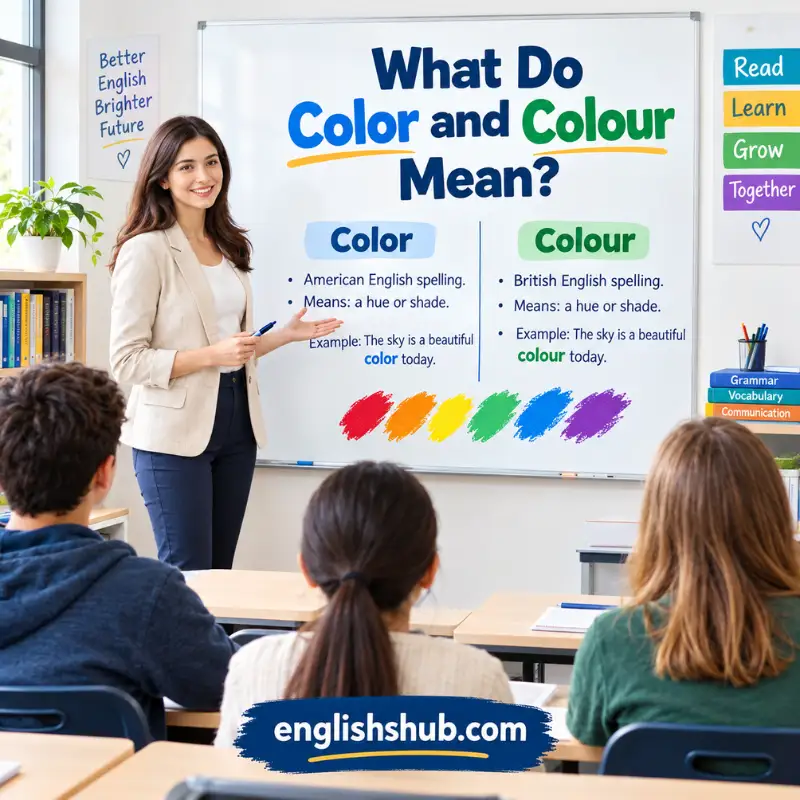
Color and colour are regional spellings of the same word. As a noun, the word commonly refers to a visual quality such as red, blue, green, or yellow. It may also refer to a pigment, a combination of hues, or the general use of hues in a design.
- The room needs more color.
- Blue is my favorite color.
- The artist mixed several colors.
The word also works as a verb. In that role, it can mean adding pigment or changing how something looks.
- Mia will color the drawing.
- They colored the frosting pink.
- Sunlight may color the clouds orange.
In addition, the verb can describe influence. For example, a past experience may color someone’s opinion. This means the experience affects how that person thinks.
The Merriam-Webster entry for color
confirms both the noun and verb uses. It also records meanings connected with visual perception, pigment, character, influence, and appearance.
Is Color Correct in American English?
Color is the correct standard spelling for an American audience. It appears in U.S. dictionaries, school materials, news publications, business documents, and most American websites.
Examples include:
- What is your favorite color?
- The designer chose a warm color scheme.
- Please print this page in color.
- The child used colored pencils.
- We need a more colorful logo.
An American teacher or editor may mark colour as inconsistent if the assignment requires American English. However, that does not make colour a fake word. It simply follows a different regional convention.
The same principle appears in other spelling pairs. American English usually favors aging, for example, while British English often uses ageing. You can read the related
for another example.
Is Colour Correct in British English?
Colour is the standard British English spelling. Writers in the United Kingdom normally retain the u in the base word and its related forms.
- What is your favourite colour?
- The garden looks colourful.
- She coloured the picture.
- The children are colouring after lunch.
British-style spelling often appears in countries that have close historical ties to British English. However, national and organizational standards can vary. Therefore, check the required dictionary or style guide when you write for a specific publication.
Do not “correct” colour to color inside an accurately copied British quotation. The original spelling carries information about the source’s language variety.
Color or Colour in Canada, Australia, and New Zealand
Canadian English generally prefers colour, especially in formal and edited writing. The Canadian government’s
guide to international spelling variations
lists colour as the British form and color as the American form. Still, Canadians encounter American spelling frequently, and some organizations may adopt it.
Australian English normally uses colour.
The Australian Government Style Manual
advises writers to follow one dictionary consistently when regional spellings vary. Its own examples use forms such as colour, favour, and grey.
New Zealand English also generally follows the British colour spelling.
Consequently, use this practical guide:
- United States: color
- United Kingdom: colour
- Canada: usually colour
- Australia: colour
- New Zealand: colour
- International organization: follow its house style
Color and Colour Word Forms
The regional difference continues when you add endings or create related words.
| Form or Meaning | American English | British English |
|---|---|---|
| Singular noun or base verb | color | colour |
| Plural noun | colors | colours |
| Third-person verb | colors | colours |
| Past tense | colored | coloured |
| Present participle | coloring | colouring |
| Descriptive adjective | colorful | colourful |
| Without color | colorless | colourless |
| Loss or change of color | discolor | discolour |
| Adding color again | recolor | recolour |
| Several colors | multicolored | multicoloured |
For American English:
The colorful bird had bright feathers.
For British English:
The colourful bird had bright feathers.
The meaning stays the same. Only the regional spelling pattern changes.
Are Color and Colour Pronounced Differently?
The extra u in colour does not add a syllable or create a separate vowel sound. Both forms have two syllables, and the stress falls on the first syllable.
A common American pronunciation is approximately KUL-er, often represented as /ˈkʌlər/. In many British accents, the ending may sound closer to KUL-uh, or /ˈkʌlə/.
However, this difference comes from accent, not from the spelling. An American and a British speaker may pronounce the word differently even while reading the same written form.
Why Are Color and Colour Spelled Differently?
English received the word through Anglo-French, with deeper roots in Latin.
According to the Online Etymology Dictionary,
colour became the usual English form during the Middle English period. However, color also appeared as an alternative centuries before modern American spelling became fixed.
Noah Webster later promoted several shorter forms in American dictionaries. These included words such as color, honor, and favor. Still, Webster did not simply invent every shorter spelling. Many forms already existed, although his dictionaries helped establish them as American standards.
Merriam-Webster’s history of Webster’s spelling reforms
explains that Webster championed existing alternatives as well as new reforms. Some choices became standard, while proposals such as soop for soup failed.
Therefore, the history is more accurate than the claim that Americans merely removed a random letter. Different spellings competed over time, and American and British standards eventually favored different forms.
The Broader -or and -our Spelling Pattern
The same regional pattern appears in several related spelling pairs.
| American English | British English |
|---|---|
| color | colour |
| behavior | behaviour |
| favor | favour |
| flavor | flavour |
| honor | honour |
| humor | humour |
| labor | labour |
| neighbor | neighbour |
However, do not remove the u from every British word ending in -our. Some words do not belong to this spelling group. For example, tour, contour, and paramour keep their spellings in American English.
The pattern provides a useful clue, but it is not a rule that applies to every word.
Common Mistakes With Color and Colour
Mixing American and British Forms
A sentence can be understandable yet inconsistent:
My favourite color is blue.
The sentence combines British favourite with American color. Choose one regional style.
American English:
My favorite color is blue.
British English:
My favourite colour is blue.
Mixing Related Word Forms
This sentence also switches conventions:
The colourful poster uses three bright colors.
Use either:
The colorful poster uses three bright colors.
Or:
The colourful poster uses three bright colours.
Assuming the Meanings Are Different
Color and colour do not name different visual concepts. Both can refer to a hue, pigment, appearance, or figurative influence.
Pronouncing the Written U
Do not add an extra vowel or syllable when you pronounce colour. The u marks a spelling convention, not an additional sound.
When a U.S. Writer May Need to Use Colour
Although color is standard in American English, a U.S. writer should sometimes preserve colour.
Proper Names and Official Titles
Do not change the spelling in a registered organization, brand, book, artwork, event, or product name.
The exhibition was titled The Colour of Memory.
Changing Colour would alter the official title.
Direct Quotations
Keep the source’s original spelling when accuracy matters.
The British report described a “change in colour.”
You may use American spelling in your surrounding explanation while preserving the quoted form.
Publication Requirements
A British journal may require colour even when the writer lives in the United States. Likewise, an American publisher may request color from a British writer.
Software and Code
Many programming languages and web standards use fixed American spellings. For example, CSS uses the property name color, not colour.
p {
  color: blue;
}
Writing colour: blue; would not create a valid CSS color declaration. In code, the technical specification matters more than the writer’s regional preference.
How to Choose Between Color and Colour
Use this three-step test.
- Identify your audience. Choose color for U.S. readers and colour for British-style readers.
- Check the required style. Follow your school, employer, client, publisher, or organization’s instructions.
- Review related spellings. Search for color, colour, favorite, favourite, honor, and honour to find accidental mixing.
For an international audience with no required style, either spelling can work. However, select one clear standard and apply it consistently.
FAQs
Use color in American English. It is the standard spelling for U.S. schools, businesses, news publications, and general writing.
No. Colour is the standard British spelling and is also common in Canadian, Australian, and New Zealand English. It may be inappropriate only when a document specifically requires American spelling.
Yes. Both forms can refer to a visual hue, pigment, appearance, or figurative influence. The difference is regional spelling, not meaning.
Use favorite color in American English. Use favourite colour in British English. Avoid mixing the forms as favourite color unless a name or quotation requires that combination.
Both are correct. Colorful is the American form, while colourful is the British form.
Follow the website’s target market and established house style. If the main audience is American, use color. If no regional standard exists, choose one spelling and remain consistent.
Canadian English generally prefers colour, particularly in formal writing. However, American color may appear in company styles, software terminology, and content aimed at U.S. readers.
Test Your Understanding
1. Which spelling is standard in American English?
A. collor
B. colur
C. color
D. colourr
2. Which sentence follows British spelling consistently?
A. My favorite colour is green.
B. My favourite colour is green.
C. My favorite color is green.
D. My favourite color is green.
3. Which American word form is correct?
A. colouring
B. colourfull
C. colored
D. colourless
4. When should an American writer preserve the spelling colour?
A. In every American essay
B. In an official British title or exact quotation
C. Only when writing about red
D. Never
5. Which CSS declaration is valid?
A. colour: red;
B. colr: red;
C. color: red;
D. coloring: red;
Answer Key
- C — color. American English normally drops the u.
- B — My favourite colour is green. Both key words follow British spelling.
- C — colored. This is the standard American past-tense form.
- B — In an official British title or exact quotation. Exact wording can override a regional preference.
- C —
color: red;. CSS uses the fixed American spellingcolor.
Conclusion
For a U.S. audience, the answer to color or colour is simple: choose color. Use colour when following British or another spelling system that retains the u. Both forms have the same meaning and basic pronunciation. Therefore, your real goal is not to prove one spelling universally correct. Instead, match your audience, preserve official wording when necessary, and maintain one consistent style.
Related Grammar and Language Guides
Ageing or Aging: Correct Spelling With Easy Examples
Acknowledgement or Acknowledgment: Which Is Correct?
Aesthetic or Esthetic: Correct Spelling and Clear Guide



[…] color or colour. […]
[…] Color or Colour: Correct Spelling, Difference & Examples […]
[…] Color or Colour: Correct Spelling, Difference & Examples […]