
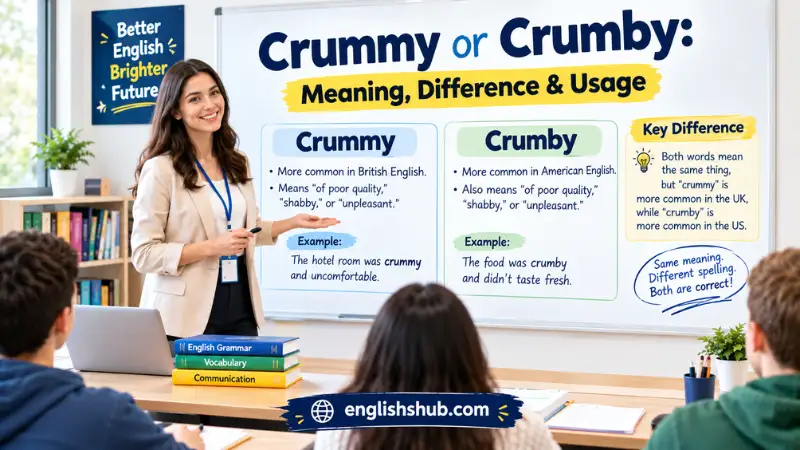
When choosing crummy or crumby, meaning matters more than spelling alone. In American English, crummy is an informal adjective meaning bad, unpleasant, inferior, or poor in quality. Crumby commonly describes something full of crumbs or having a crumb-like texture. However, dictionaries also recognize crumby as a variant of crummy in some uses.
That overlap explains why the two forms are easy to confuse. They are pronounced alike in ordinary American English, but their clearest uses are different. If you mean “bad,” crummy is the clearest choice. If you mean “full of crumbs,” crumby communicates that literal idea.
Quick Answer
Use crummy when you mean bad, unpleasant, inferior, shabby, or poor-quality. Use crumby when you mean full of crumbs or crumb-like. Some dictionaries also recognize crumby as a variant of crummy, so it is not simply a nonexistent word. For clear U.S. writing, however, meaning should guide your spelling.
TL;DR
- Crummy means bad, unpleasant, inferior, or poor-quality.
- Crumby commonly means full of crumbs or crumb-like.
- Crumby can also be a variant of crummy.
- Both words are pronounced approximately /ˈkrʌm.i/.
- Crummy is informal, so formal writing may need a more precise word.
- Choose the spelling that makes your intended meaning clearest.
Crummy vs. Crumby at a Glance
| Feature | Crummy | Crumby |
|---|---|---|
| Main U.S. meaning | Bad or poor-quality | Full of crumbs or crumb-like |
| Part of speech | Adjective | Adjective |
| Register | Informal | Usually neutral when literal |
| Example | a crummy hotel | a crumby countertop |
| Variant use | Main form for “bad” | Also recognized as a variant of crummy |
| Pronunciation | /ˈkrʌm.i/ | /ˈkrʌm.i/ |
What Does Crummy Mean?
Crummy is an informal adjective used for something that is bad, unpleasant, inferior, shabby, cheap, or unsatisfactory. Cambridge labels the word informal and defines it in terms of very poor quality. Collins likewise gives meanings connected with unpleasantness and poor quality.
It can describe many kinds of things:
- a crummy hotel
- a crummy job
- crummy weather
- a crummy excuse
- a crummy movie
- a crummy experience
For example:
We had a crummy hotel room.
Here, crummy means the hotel room was poor or unpleasant.
The printer gave me a crummy copy.
In this sentence, the copy was low-quality.
The word can also describe an unpleasant situation:
I had a crummy morning.
The sentence does not mean the morning contained crumbs. It means the experience was bad or disappointing.
Because crummy is informal, it works especially well in conversation, casual writing, dialogue, and personal comments.
What Does Crumby Mean?
Crumby commonly describes something that contains, has, or resembles crumbs. Collins lists crumby in American English as meaning “full of crumbs,” while Dictionary.com also records the meanings “full of crumbs” and “soft.”
Examples include:
The kitchen counter is crumby after breakfast.
The children left the table crumby after eating cookies.
This cake has a soft, crumby texture.
In each example, the word connects directly to crumbs or crumb-like texture.
This use is especially natural in food, baking, cooking, and household descriptions.
Compare:
- The table is crumby. → It has crumbs on it.
- The table is crummy. → It is poor-quality, shabby, or unpleasant.
The spelling changes the likely interpretation.
Crummy or Crumby: What Is the Main Difference?
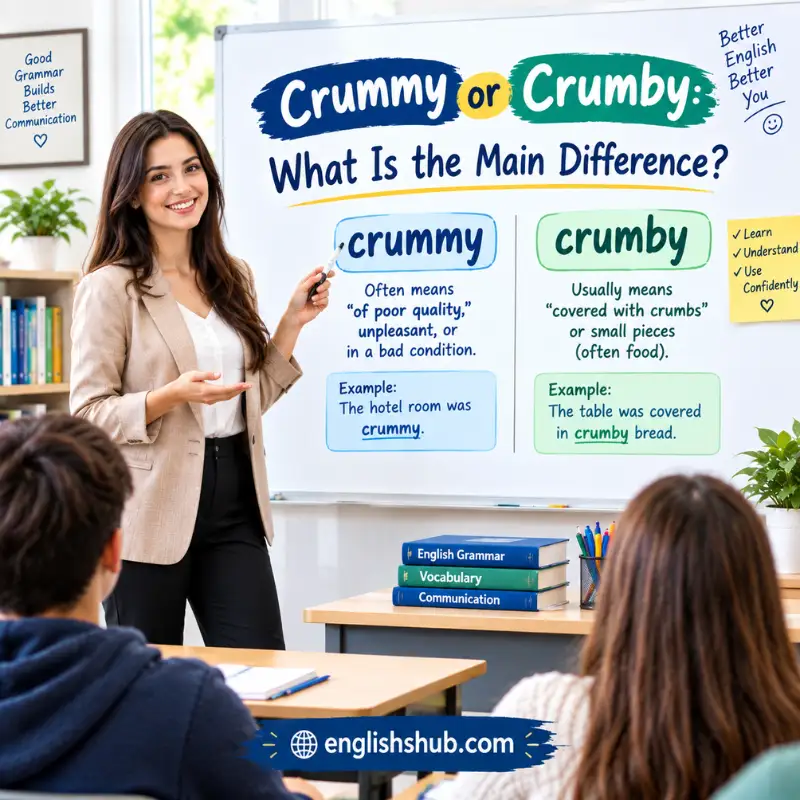
The simplest distinction is based on the idea you want to express.
If the word means “bad,” choose crummy.
If it means “full of crumbs” or “crumb-like,” choose crumby.
Consider these pairs:
We stayed in a crummy motel.
The motel was poor or unpleasant.
The motel table was crumby.
The table had crumbs on it.
Another pair:
The restaurant had crummy service.
The service was poor.
The restaurant table was crumby.
The table had crumbs on it.
The words can therefore appear in the same general situation while describing completely different qualities.
A quick replacement test
Try replacing the word with lousy.
If the sentence still makes sense, crummy is probably correct:
It was a crummy movie.
It was a lousy movie.
Now try replacing it with full of crumbs:
The counter was crumby.
The counter was full of crumbs.
That test handles most everyday spelling decisions.
Is Crumby Also a Variant of Crummy?
Yes. This is where the distinction becomes more nuanced.
Collins records crumby as an American informal form of crummy. Dictionary.com also gives crumby a separate American sense meaning “crummy.”
Therefore, a sentence such as:
That was a crumby deal.
can be understood as meaning:
That was a crummy deal.
However, the two forms are not equally clear for every meaning. When you mean “bad” or “poor-quality,” crummy is the clearer default in American English. When you mean actual crumbs, crumby provides useful information that crummy does not.
This is why calling crumby simply “wrong” would be inaccurate. It is a legitimate dictionary word with its own crumb-related meanings and an overlapping variant use.
The safest approach is to let the intended meaning determine the spelling.
Crummy in American English: Is It Formal?
Crummy is informal. Cambridge specifically labels it informal, and Collins similarly identifies informal usage in its dictionary treatment.
That does not make the word grammatically wrong. It simply makes it less suitable for some situations.
Natural informal writing
We had a crummy flight.
That’s a crummy excuse.
The service was pretty crummy.
These sentences sound natural in casual conversation.
More precise formal writing
Instead of:
The equipment was crummy.
You might write:
The equipment was inadequate.
Instead of:
The service was crummy.
You might write:
The service was poor.
Instead of:
The results were crummy.
You might write:
The results were disappointing.
The best replacement depends on what is actually wrong. Poor, inadequate, inferior, unreliable, and disappointing are not perfect synonyms.
Crumby in Food and Texture Descriptions
Crumby is especially useful when the subject relates directly to crumbs or texture.
For example:
The counter became crumby while we were making toast.
The pastry has a soft, crumby center.
The children left the couch crumby after eating cookies.
The meaning can be physical rather than evaluative.
This distinction matters because crummy can also describe food, but it gives a negative evaluation:
The cookies were crummy.
This means the cookies were bad or disappointing.
Compare that with:
The cookies were crumby.
This describes a crumb-related quality or texture.
The second sentence does not necessarily say that the cookies were bad.
That is an important substitution limit: crumby can describe physical texture without judging quality, while crummy usually expresses a negative judgment.
Pronunciation and Word Forms
Both crummy and crumby are normally pronounced approximately /ˈkrʌm.i/ in American English. Cambridge gives this pronunciation for both forms.
The pronunciation does not help you choose the spelling. Context does.
The words also form their comparative and superlative forms differently:
Crummy
- crummy
- crummier
- crummiest
Examples:
This hotel is crummy.
That hotel is even crummier.
It was the crummiest room on the trip.
Crumby
- crumby
- crumbier
- crumbiest
Examples:
The counter is crumby.
The kitchen became crumbier after the children ate.
This was the crumbiest table in the house.
Notice that crummy doubles the m before -ier and -iest, while crumby changes the final y to i without doubling the m.
Crummy and Crumby: Synonyms, Near-Synonyms, and Contrasts
For the negative meaning of crummy, useful alternatives include:
- bad — broad and neutral
- poor — common and suitable for many formal contexts
- lousy — informal and close to crummy
- inferior — emphasizes lower quality
- shabby — often suggests poor condition or appearance
- substandard — emphasizes failure to meet a standard
These words are related, but they are not interchangeable in every sentence.
For example:
The apartment was shabby.
This often suggests worn, neglected, or poor physical condition.
The apartment was inferior.
This suggests that it was lower in quality compared with something else.
The apartment was crummy.
This is broader and more conversational.
For crumby, the closest alternatives depend on the context. Crumb-filled, covered with crumbs, and crumbly can sometimes express related ideas, but they are not identical.
For example:
The counter was covered with crumbs.
This clearly describes the physical condition.
The cake was crumbly.
This describes a texture that breaks apart easily.
The counter was crumby.
This focuses on the presence of crumbs.
Common Mistakes With Crummy and Crumby
Mistake 1: Using crumby for poor quality
If you mean “bad,” write:
The hotel was crummy.
Not:
The hotel was crumby.
Crumby can function as a variant of crummy, but crummy is clearer for this negative meaning.
Mistake 2: Using crummy when you mean crumbs
If you mean a surface contains crumbs, write:
The kitchen table is crumby.
Using crummy could make the reader think you are criticizing the table’s quality.
Mistake 3: Assuming crumby is never correct
That is too broad.
Crumby is a legitimate adjective. Major dictionaries record its crumb-related meaning and its variant relationship with crummy.
Mistake 4: Treating crummy as a formal replacement for every negative adjective
A sentence such as:
The report contains crummy data.
may be understandable, but a formal report might need a more exact description such as inaccurate data, incomplete data, or unreliable data.
The best word depends on the actual problem.
A Simple Decision Rule for Crummy or Crumby
Use this two-question method:
1. Does the word mean “bad, poor, unpleasant, or inferior”?
Use crummy.
We had a crummy experience.
2. Does the word mean “full of crumbs” or describe a crumb-like texture?
Use crumby.
The table was crumby after breakfast.
If crumby is being used to mean “bad,” it can be understood because dictionaries recognize that variant. Still, crummy is the clearer U.S. choice for that meaning.
A simple memory aid is:
Crummy = lousy.
Crumby = crumbs.
It is a practical reminder, not a complete description of every dictionary sense.
FAQs
Yes. Crummy is a dictionary-recognized adjective. In American English, it is an informal word for something bad, inferior, unpleasant, shabby, or poor-quality. It can also have specialized noun uses in some varieties of English.
Yes. Crumby is a real adjective meaning full of crumbs or crumb-like. Major dictionaries also recognize it as a variant of crummy in some contexts.
Both are legitimate words, but the intended meaning matters. Use crummy for bad or poor-quality and crumby for something full of crumbs or crumb-like. When crumby means “bad,” it is a recognized variant, but crummy is clearer.
Some dictionaries describe crummy as slang, while Cambridge labels it informal. In practical U.S. writing, treat it as an informal adjective. It is natural in conversation but may sound too casual for formal academic or professional writing.
Yes. In ordinary American English, both are pronounced approximately /ˈkrʌm.i/. The silent b in crumby does not create a pronunciation difference.
It can be correct when you mean the cake has a crumb-related or crumb-like texture. If you mean the cake tastes bad or is poor-quality, use crummy instead.
Associate the b in crumby with bread crumbs. Use crummy when you mean something is bad or lousy. Remember, however, that dictionaries also recognize crumby as a variant of crummy in some uses.
Test Your Understanding
- Which word best completes the sentence: “We stayed in a ___ hotel”?
A. crumby
B. crummy
C. crumbier
D. crumb
- Which sentence clearly uses crumby in its literal sense?
A. The movie was crumby.
B. The service was crumby.
C. The counter was crumby after breakfast.
D. The job was crumby.
- Which statement about crummy is accurate?
A. It is always formal.
B. It normally means full of crumbs.
C. It is an informal word meaning bad or poor-quality.
D. It is only used in British English.
- Which form is the correct comparative of crummy?
A. crumier
B. crummier
C. crumbyer
D. crummyer
- Which sentence is most suitable for a formal report?
A. The equipment was crummy.
B. The equipment was lousy.
C. The equipment was inadequate.
D. The equipment was crumby.
Answer Key
- B. Crummy means bad or poor-quality, which describes an unpleasant or low-quality hotel.
- C. Crumby means full of crumbs or crumb-related, so the counter sentence gives the literal meaning.
- C. Crummy is an informal adjective commonly used to describe something bad, inferior, or unpleasant.
- B. The comparative form is crummier, with the final consonant doubled before -ier.
- C. Inadequate is more precise and formal than the informal word crummy.
Conclusion
When choosing crummy or crumby, start with the meaning. Use crummy for something bad, inferior, unpleasant, or poor-quality, especially in informal American English. Use crumby when describing crumbs or a crumb-like quality. Although dictionaries recognize crumby as a variant of crummy in some uses, crummy is the clearest choice for the negative meaning. The easiest reminder is simple: crummy means lousy; crumby points to crumbs.
Related Grammar and Language Guides
Coozie or Koozie? The Correct Spelling and Usage Guide
Color or Colour: Correct Spelling, Difference & Examples
Ambience or Ambiance: Correct Spelling With Examples