
When choosing between camouflage or camoflauge, always write camouflage. The second form is a common misspelling that moves the letter u to the wrong position. It is not an alternative American or British spelling.
The correct word can describe a method of hiding something, a pattern that helps something blend in, or the act of concealing something. For example, a rabbit’s fur may provide camouflage, while paint can camouflage a small mark.
Because the pronunciation does not reveal every letter clearly, sounding out the word may cause mistakes. However, a simple division—camou + flage—makes the correct order easier to remember.
Quick Answer
In camouflage or camoflauge, camouflage is the correct spelling. Write it as C-A-M-O-U-F-L-A-G-E. Camoflauge incorrectly moves the u into the final part of the word. The correct spelling works in both American and British English as a noun, verb, or noun modifier.
TL;DR
- Camouflage is the only standard spelling.
- Camoflauge places the u in the wrong position.
- Camoflage incorrectly leaves the u out.
- Remember the two chunks: camou + flage.
- The correct -ing form is camouflaging.
- American and British English use the same spelling.
Correct and Incorrect Forms at a Glance
| Form | Status or Function | Example or Correction |
|---|---|---|
| camouflage | Correct base word | The moth uses camouflage. |
| camoflauge | Incorrect letter order | Change to camouflage. |
| camoflage | Incorrect; missing u | Change to camouflage. |
| camouflaged | Correct past form | Trees camouflaged the cabin. |
| camouflaging | Correct -ing form | Makeup is camouflaging the mark. |
| camo | Informal shortened form | He wore a camo jacket. |
Which Spelling Is Correct: Camouflage or Camoflauge?
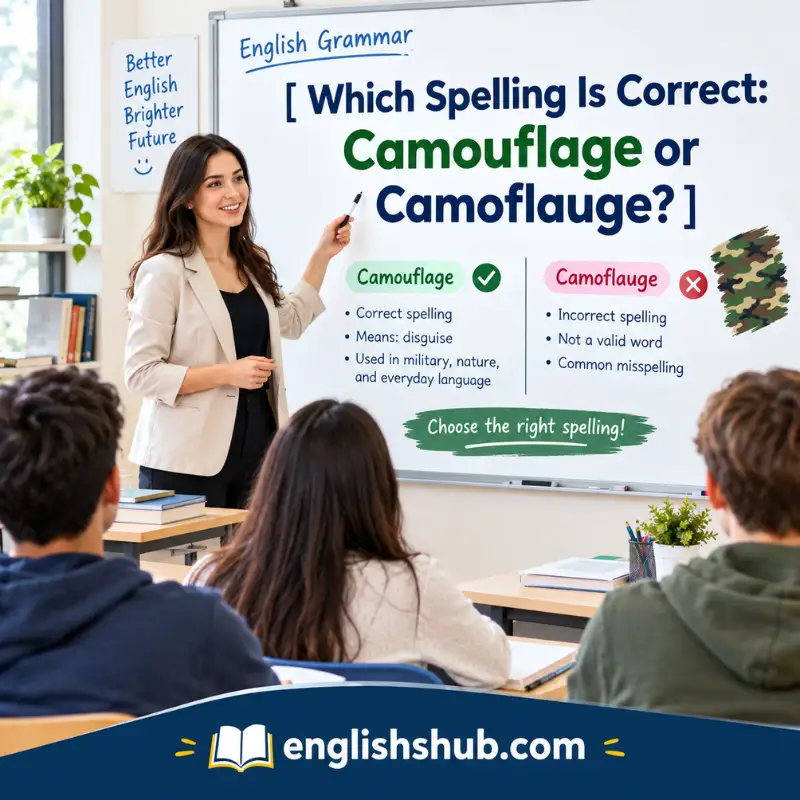
Camouflage is the correct spelling. Major dictionaries list this form as a noun, verb, and modifier. For instance, the
Merriam-Webster entry for camouflage
records military, natural, and figurative senses.
Correct:
- The insect’s coloring provides camouflage.
- The artist used paint to camouflage the scratch.
- Riley bought a camouflage jacket.
Incorrect:
- The insect’s coloring provides camoflauge.
- Riley bought a camoflage jacket.
Furthermore, this is not a regional choice. American and British dictionaries use camouflage. Therefore, unlike the legitimate regional choices covered in
neither misspelling becomes correct in British English.
Why Do People Write Camoflauge?
People often write camoflauge because the middle of camouflage is hard to hear. The unstressed vowel sounds encourage writers to spell the word as they think it sounds.
The mistake involves more than reversing f and l. Compare the exact chunks:
- Correct: camou + flage
- Incorrect: camo + flauge
In camoflauge, the u has moved from the first chunk into the second. Meanwhile, camoflage creates a different mistake by removing the u completely.
Similar uncertainty can occur when a word contains an unexpected letter pattern. However, each spelling question needs its own evidence. For example,
includes a recognized secondary variant, while camoflauge does not function as a standard variant.
How to Spell Camouflage Correctly
Use this four-step spelling check:
- Start with camo.
- Add u to produce camou.
- Add flage.
- Check that the ending is flage, not flauge.
The completed form is:
CAMOU + FLAGE = CAMOUFLAGE
A useful memory line is: The “u” hides inside camou. Since camouflage involves hiding, that connection can help you recall where the letter belongs.
You can also write the letters in three groups:
CAM – OU – FLAGE
Do not depend entirely on autocorrect. A spelling tool may catch the error, but the chunking method helps when writing by hand, completing a test, or proofreading a heading.
What Does Camouflage Mean?
Camouflage means concealment through disguise or by blending with the surrounding environment.
The Oxford Learner’s Dictionary definition
records military, animal, and figurative uses.
The word appears in several contexts:
- Military: The net provided camouflage for the vehicle.
- Wildlife: The frog’s coloring acts as camouflage among the leaves.
- Clothing: Theo wore camouflage pants.
- Cosmetics: The concealer helped camouflage the redness.
- Figurative language: Her cheerful tone was camouflage for her concern.
The central idea remains concealment. However, the method can differ. A uniform may blend into a landscape, while behavior may hide a person’s true feelings.
Camouflage as a Noun, Verb, and Modifier
Camouflage performs three common grammatical jobs.
Camouflage as a noun
As a noun, it names concealment, a disguising pattern, or the material used to hide something:
- The snow gave the fox effective camouflage.
- Workers placed camouflage over the equipment.
- His confidence served as camouflage for his nervousness.
The noun is often uncountable. Therefore, camouflages is uncommon when referring generally to military or natural concealment.
Camouflage as a verb
As a verb, camouflage means “to hide or disguise”:
- Dense vines camouflaged the entrance.
- Maya used a rug to camouflage the stain.
- Some insects camouflage themselves as leaves.
Camouflage before another noun
The word can also describe the type or pattern of another noun:
- camouflage jacket
- camouflage net
- camouflage pattern
- camouflage paint
In such phrases, camouflage functions as a noun modifier.
Correct Word Forms of Camouflage
The verb follows the regular spelling pattern for words ending in silent e.
| Grammatical Form | Correct Spelling | Example |
|---|---|---|
| Base form | camouflage | Plants camouflage the fence. |
| Third-person singular | camouflages | The pattern camouflages dirt. |
| Past tense | camouflaged | Fog camouflaged the shoreline. |
| Past participle | camouflaged | Workers had camouflaged the shelter. |
| Present participle | camouflaging | She is camouflaging the repair. |
For camouflaging, remove the final e before adding -ing:
camouflage − e + ing = camouflaging
Therefore, camouflageing is incorrect. This formation differs from plural spelling questions such as
where the final letter and the preceding vowel determine whether to add -s or -ies.
How to Pronounce Camouflage
In standard American English, camouflage is commonly pronounced approximately KAM-uh-flahzh. The main stress falls on the first syllable.
A common U.S. IPA representation is:
/ˈkæməˌflɑːʒ/
The final sound resembles the sound at the end of massage. Cambridge provides audio through its
camouflage pronunciation guide.
However, pronunciation does not provide a reliable spelling map. The letters ou do not stand out clearly in ordinary speech. Consequently, learners may omit or move the u. Use pronunciation to speak the word, but use camou + flage to spell it.
Where Did the Word Camouflage Come From?
English borrowed camouflage from French. The French verb camoufler means “to disguise” or “make unrecognizable.”
The word became strongly connected with military concealment during World War I. However, some evidence places related nonmilitary English use earlier. Merriam-Webster, for example, records an earlier noun sense and later military verb use.
The Online Etymology Dictionary history of camouflage
dates its English military-era noun, verb, and adjective use to 1917. It also connects the term with French camoufler and Italian camuffare. Still, sources differ about the deeper origin of the French word. Therefore, the French connection is secure, while the earliest underlying root deserves cautious wording.
Is Camouflage Spelled Differently in British English?
No major British spelling change applies. Standard American and British references both use camouflage.
Correct in U.S. English:
- The uniform provided camouflage.
Correct in U.K. English:
- The uniform provided camouflage.
Incorrect in standard writing:
- The uniform provided camoflauge.
This situation differs from pairs in which both forms are established. For example, both spellings discussed in
have dictionary support. With camouflage, writers should use the same standard spelling regardless of their intended English-speaking audience.
Camouflage Synonyms and Their Differences
Useful alternatives include hide, conceal, disguise, mask, and blend in. However, they are not perfect substitutes in every sentence.
The Merriam-Webster camouflage thesaurus
lists several of these related terms.
| Alternative | Main Idea | Limitation |
|---|---|---|
| hide | Keep something from view | Does not explain how |
| conceal | Prevent discovery | More formal and general |
| disguise | Change appearance or identity | May involve looking like something else |
| mask | Cover or obscure | Often figurative or partial |
| blend in | Avoid standing out | Does not always involve intentional concealment |
| reveal | Make visible or known | Contextual opposite |
| expose | Remove concealment | Stronger contextual opposite |
Compare:
- The leaves hid the box.
- The leaves camouflaged the box.
The first sentence says the box could not be seen. The second suggests that the leaves made it resemble its surroundings. Therefore, camouflage gives more information about the method.
Common Camouflage Spelling and Usage Mistakes
Moving the letter U
Incorrect: The animal’s camoflauge protected it.
Correct: The animal’s camouflage protected it.
The u belongs before flage, not inside it.
Leaving out the letter U
Incorrect: She wore a camoflage hat.
Correct: She wore a camouflage hat.
Always check for ou after cam.
Writing camouflageing
Incorrect: The paint is camouflageing the damage.
Correct: The paint is camouflaging the damage.
Drop the final silent e before adding -ing.
Treating camo as formal spelling
Camo is an accepted informal shortening, especially for clothing and patterns. Nevertheless, use camouflage in school papers, reports, and other formal prose.
Changing an intentional name
A business, username, song, or creative title might deliberately use Camoflauge. Preserve that spelling when reproducing the official name or an exact quotation. Outside that special context, correct it to camouflage. The need to preserve established forms also arises with valid alternatives such as
acknowledgement or acknowledgment.
FAQs
Camouflage is correct in standard English. Camoflauge moves the u into the wrong part of the word, so correct it unless it belongs to an intentional proper name.
No. Camoflage leaves out the required u. The correct sequence is c-a-m-o-u-f-l-a-g-e.
Divide the word into camou + flage. Remember that the u “hides” inside the first chunk, which connects the spelling with the word’s meaning.
The noun camouflage is usually uncountable, as in “The animals use camouflage.” In specialized contexts, camouflages may refer to different systems or types, but most everyday sentences do not need a plural.
Camo is an informal shortening of camouflage. It works naturally for clothing or patterns in casual writing, but the full word is safer in formal prose.
It can be both. In “The fur provides camouflage,” it is a noun. In “The fur camouflages the animal,” it is a verb.
No. British and American English both use camouflage. Camoflauge is not a regional spelling variant.
Test Your Understanding
- Which spelling is correct in standard English? A. Camoflauge
B. Camoflage
C. Camouflage
D. Camauflage - Which sentence uses camouflage as a verb? A. The jacket has a camouflage pattern.
B. The leaves camouflage the shelter.
C. The animal’s camouflage is effective.
D. We purchased camouflage yesterday. - Which is the correct present participle? A. Camoflauging
B. Camouflageing
C. Camoflaging
D. Camouflaging - Which spelling division provides the best memory aid? A. Camo + flauge
B. Camou + flage
C. Camof + lage
D. Ca + mouflauge - Which statement is accurate? A. Camoflauge is the British spelling.
B. Camoflage is acceptable in informal English.
C. Camo is the preferred form in formal reports.
D. Camouflage can function as a noun or verb.
Answer Key
- C — Camouflage. It contains the correct camou + flage letter sequence.
- B — The leaves camouflage the shelter. The word expresses the action of disguising the shelter.
- D — Camouflaging. Remove the final e from camouflage before adding -ing.
- B — Camou + flage. This division keeps the u in its correct position.
- D — Camouflage can function as a noun or verb. It can name concealment or describe the act of concealing.
Conclusion
For camouflage or camoflauge, choose camouflage in every ordinary English context. The misspelling camoflauge moves the u, while camoflage leaves it out. Remember camou + flage, and use the same spelling in American and British English. Also check related forms carefully: camouflages, camouflaged, and camouflaging. An intentional proper name may preserve a different spelling, but that exception does not change the standard word.
Related Grammar and Language Guides
Barbeque or Barbecue: A Clear Correct Spelling Guide
Attornies or Attorneys: Which Spelling Is Correct?
At Least or Atleast: Correct Spelling and Usage