
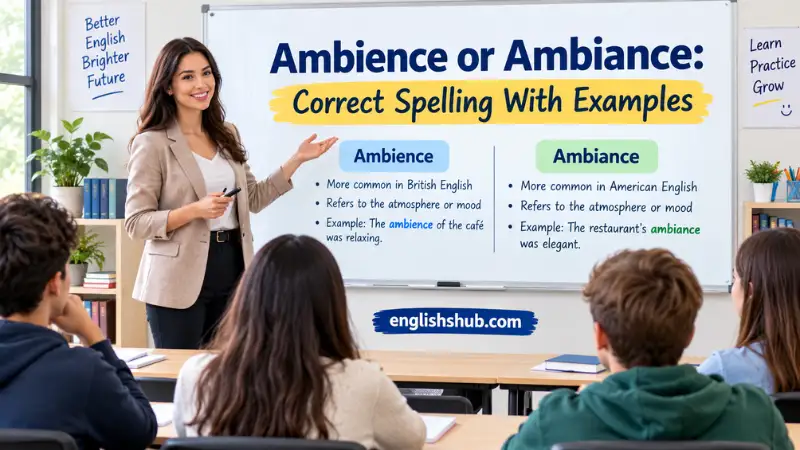
Both words in ambience or ambiance are correct spellings of the same noun. They describe the mood, feeling, or character of a place, event, person, or creative work. For general American English, ambience is the safer default because major U.S. dictionaries use it as the main entry and list ambiance as a variant.
Still, ambiance is not a mistake. It preserves the modern French spelling and appears often in restaurant, hospitality, art, décor, and lifestyle writing. Therefore, your choice usually depends on house style, reader expectations, and consistency—not a difference in meaning. Preserve ambiance when it forms part of an official name, title, or direct quotation.
Quick Answer
Both spellings in ambience or ambiance mean the atmosphere, mood, or character associated with a place or experience. American English accepts both, although ambience is the safest general spelling. British English also usually favors ambience. Choose ambiance if a house style, official name, title, or quotation requires it, and remain consistent elsewhere.
TL;DR
- Ambience and ambiance have the same meaning.
- Ambience is the safest default in general American English.
- Ambiance is a valid French-influenced variant.
- Both spellings can take either common English pronunciation.
- Preserve official wording; otherwise, choose one spelling consistently.
Ambience vs. Ambiance at a Glance
| Feature | Ambience | Ambiance |
|---|---|---|
| Correct English spelling | Yes | Yes |
| Core meaning | Atmosphere, mood, or character | The same |
| General U.S. default | Safer choice | Accepted variant |
| British English | Usually preferred | Recognized but less typical |
| Part of speech | Noun | Noun |
| Pronunciation | AM-bee-uhns or ahm-bee-AHNSS | Either pronunciation can occur |
What Is the Difference Between Ambience and Ambiance?
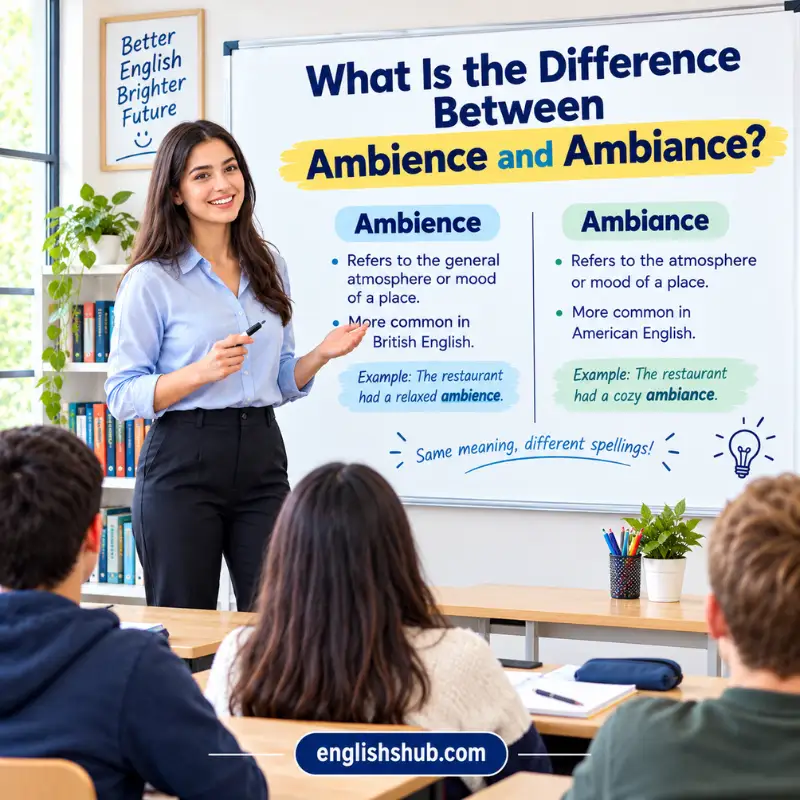
The difference lies in spelling and historical form, not meaning. Both nouns refer to the feeling or character created by a setting and everything within it.
Compare these sentences:
- Soft jazz gave the lounge a relaxed ambience.
- Soft jazz gave the lounge a relaxed ambiance.
The sentences make the same claim. Neither spelling makes the lounge more formal, stylish, or French.
Merriam-Webster defines ambience as a feeling or mood connected with a place, person, or thing
and lists ambiance as a variant. Likewise,
Collins records ambience, also ambiance,
for the character and atmosphere of a place.
Because both forms are legitimate, a spell-check flag may reflect a selected dictionary or house preference. It does not prove that the other form is not English. A similar spelling-choice issue appears in
where valid variants share a definition.
What Do Ambience and Ambiance Mean?
Ambience and ambiance describe the overall impression that surrounds a person. That impression may come from lighting, sound, color, temperature, behavior, architecture, smell, or social energy.
The noun most often describes a place:
- The library has a quiet, focused ambience.
- Candles created a romantic ambiance in the dining room.
However, the idea can extend beyond physical rooms:
- The director gave the film an uneasy ambience.
- Friendly volunteers shaped the festival’s welcoming ambiance.
- Her calm manner changed the ambience of the meeting.
The word does not automatically mean “pleasant atmosphere.” A space can have a tense, cold, eerie, chaotic, or unfriendly ambience. Context and modifiers tell the reader whether the surrounding feeling is positive, negative, or neutral.
Also, ambience is the overall effect, not one isolated object. A lamp contributes to a room’s ambience, but the lamp alone is not usually “the ambience.”
Which Spelling Is Better in American English?
For general U.S. writing, choose ambience unless another authority controls the wording. Merriam-Webster and Collins both present ambience as the main headword and ambiance as an accepted variant. This treatment makes ambience a dependable choice for school assignments, news copy, business reports, reviews, and most website content.
However, American writers also use ambiance. The French-looking form may appear in hospitality, interior design, food, travel, luxury branding, and the arts. That pattern is a tendency, not a separate rule or meaning.
Use ambiance when:
- an employer or publisher requires it;
- a brand or product uses it officially;
- a title contains that spelling;
- a direct quotation must remain exact; or
- the document has already established that form consistently.
Do not switch to ambiance merely to make a sentence sound more sophisticated. Clear context creates tone more effectively than a variant spelling does.
Ambience or Ambiance in British and International English
British English generally favors ambience. Therefore, the same spelling often works well for both U.S. and UK audiences. This pair is not a neat split like American color and British colour.
Other English-speaking regions may show both forms. In addition, global organizations often follow an internal dictionary rather than copying the dominant spelling of one country. If you write for a Canadian, Australian, Irish, Indian, or international publication, check its house style before assuming a preference.
Consistency matters more than forcing a national label. For example:
- Consistent: The hotel’s ambience feels warm, but the lobby’s ambience feels brighter.
- Distracting: The hotel’s ambience feels warm, but the lobby’s ambiance feels brighter.
The second sentence is not grammatically false, but the unexplained switch looks accidental. EnglishsHub’s guide to
acknowledgement or acknowledgment
shows why regional choices often require both audience awareness and document-level consistency.
How to Pronounce Ambience and Ambiance
English commonly uses two pronunciations:
- AM-bee-uhns — /ˈam-bē-ən(t)s/
- ahm-bee-AHNSS — /ˈäm-bē-än(t)s/
The first sounds more fully anglicized. The second sounds more French-influenced.
Merriam-Webster records both pronunciations,
while Collins also shows English and French-influenced patterns.
Either spelling can take either pronunciation in American speech. In other words, ambiance does not require the French-like sound, and ambience does not forbid it. Many speakers use AM-bee-uhns for both spellings.
Do not pronounce the ending like the word ants with a clear t. The dictionary notation places the t in parentheses because speakers may produce only a slight sound there or omit it.
The safest speaking choice for a general U.S. audience is AM-bee-uhns. Still, the alternative remains recognized.
Where the Two Spellings Came From
The spellings reflect two stages in the word’s English history.
The Online Etymology Dictionary traces ambience
to French ambiance and ultimately to a Latin root connected with going around or surrounding. Its record places the English noun ambience in the late 1700s.
Later, English adopted the French-looking form again.
describes it as a 20th-century reborrowing used in art writing for an atmospheric effect.
This timeline explains why calling ambiance the “original English spelling” can mislead readers. It resembles the modern French source more closely, but ambience had already existed in English for a long time.
The shared deeper idea is “surrounding.” It also appears in ambient, a related word for something present around a place, such as ambient light or sound. History supports the relationship, but modern grammar still assigns the words different jobs.
Grammar: Articles, Plurals, and “Ambience Of”
Ambience and ambiance are nouns. They often behave like singular mass nouns because they name an overall quality.
Using an article
Use the for a specific atmosphere:
- We enjoyed the ambience of the old theater.
Use a or an when describing one kind of atmosphere. Because both spellings begin with a vowel sound, use an:
- The plants created an inviting ambience.
- Dim lights produced an eerie ambiance.
Using the “of” pattern
The common structure is the ambience of + noun:
- the ambience of the café
- the ambiance of the celebration
- the ambience of a small coastal town
Forming the plural
Writers usually keep the noun singular. However, ambiences and ambiances are possible when comparing distinct environments:
- The two restaurants offer very different ambiences.
In ordinary prose, a rewrite may sound smoother: “The two restaurants have very different atmospheres.”
Common Ambience and Ambiance Collocations
Natural word partnerships make this noun sound more fluent.
| Pattern | Common choices | Example |
|---|---|---|
| Positive adjective + noun | warm, relaxed, inviting, lively, cozy | The café has a warm ambience. |
| Negative adjective + noun | tense, gloomy, sterile, eerie, hostile | Silence gave the hall an eerie ambiance. |
| Neutral adjective + noun | formal, urban, rustic, historic, modern | The exposed brick creates a rustic ambience. |
| Verb + noun | create, enhance, change, improve | Plants enhance the office ambience. |
| Verb + noun | enjoy, notice, prefer, appreciate | Guests appreciated the calm ambiance. |
| Damage verb + noun | spoil, ruin, disrupt, weaken | Loud alerts ruined the peaceful ambience. |
Writers also use sense of ambience and overall ambience, although the second phrase can become redundant if the sentence already describes a total impression.
Choose specific details when possible. “The restaurant had a nice ambience” is correct but vague. “Amber lights and soft piano music created a calm ambience” shows readers what produced the feeling.
Examples in Different Contexts
Restaurants and hospitality
- The rooftop’s open firepits create a welcoming ambience.
- Guests praised the food but disliked the noisy ambiance.
The first sentence explains what creates the effect. The second proves that the noun can appear in a negative judgment.
Workplaces
- Natural light improved the office ambience.
- The manager’s angry speech changed the ambiance of the room.
A workplace atmosphere can come from physical design or human behavior.
Events
- String lights gave the reception a festive ambience.
- Heavy security created a tense ambiance outside the venue.
Again, the spellings remain interchangeable. The adjectives festive and tense establish the mood.
Art and media
- Slow camera movement gives the film a dreamlike ambience.
- Sparse dialogue strengthens the play’s unsettling ambiance.
Creative works can create an atmosphere even when the audience does not occupy the fictional place.
People and groups
- Her patient manner added a calm ambience to the discussion.
This use is possible because Merriam-Webster’s definition includes feelings associated with a person or thing. Still, manner, presence, or tone may sound more direct when describing one person.
Ambience vs. Ambient
Ambience is normally a noun, while ambient is usually an adjective. Use ambience to name the surrounding mood. Use ambient to describe something present around a place.
- Noun: The candles changed the room’s ambience.
- Adjective: The ambient light made the room feel softer.
- Adjective: Engineers measured the ambient temperature.
- Adjective: The microphone captured ambient sound.
Merriam-Webster defines ambient
as existing or present on all sides and gives examples such as ambient air temperature, light, and sound.
Common correction:
- Incorrect: The restaurant has a relaxing ambient.
- Correct: The restaurant has a relaxing ambience.
The first sentence needs a noun for the restaurant’s overall atmosphere. Ambient usually needs another noun after it, as in ambient lighting or ambient music.
Ambience vs. Atmosphere, Mood, Vibe, and Setting
Several words overlap with ambience, but they do not work identically in every sentence.
| Word | Typical meaning and tone | Example |
|---|---|---|
| atmosphere | Closest broad synonym; neutral and flexible | The room has a friendly atmosphere. |
| mood | Emotional quality of a place, person, or work | The music creates a reflective mood. |
| vibe | Informal impression or feeling | The café has a relaxed vibe. |
| setting | Physical location or surrounding circumstances | The garden provides a beautiful setting. |
| aura | Distinctive quality that seems to surround someone or something | The building has an aura of mystery. |
| tone | Attitude or emotional character, especially in speech or writing | The email has a formal tone. |
Atmosphere is the closest general substitute. Vibe sounds casual, so it may not suit an academic report. Setting names the surroundings rather than the feeling they create.
Compare:
- The stone walls create a historic ambience.
- The stone walls create a historic setting.
The first focuses on the feeling. The second focuses more on the physical scene. Therefore, the words overlap without becoming perfect synonyms. For another pair whose meanings depend on context rather than spelling alone, review
Common Mistakes and Corrections
Calling ambiance incorrect
Incorrect claim: Ambiance is a misspelling.
Correction: Major dictionaries recognize it as a variant of ambience.
Giving the spellings different meanings
Incorrect claim: Ambience means atmosphere, but ambiance means elegant décor.
Correction: Both forms can describe any positive, negative, or neutral atmosphere.
Using the wrong article
Incorrect: The room has a inviting ambience.
Correct: The room has an inviting ambience.
The pronunciation begins with a vowel sound, so an is required.
Confusing ambience with ambient
Incorrect: Soft music improved the restaurant’s ambient.
Correct: Soft music improved the restaurant’s ambience.
Use ambient before a noun, as in ambient music.
Switching spellings randomly
Inconsistent: We loved the lobby’s ambience, but the dining room’s ambiance felt cold.
Consistent: We loved the lobby’s ambience, but the dining room’s ambience felt cold.
The first version remains understandable. However, the unexplained change can look careless.
Altering official wording
If a venue calls itself “Ambiance Event Hall,” preserve that name. Do not silently rename it “Ambience Event Hall.” The same rule applies to titles and direct quotations. EnglishsHub’s
guide offers another example of why official or established forms may override a general default.
How to Choose Ambience or Ambiance
Use this five-step method:
- Choose ambience as the general default. It works naturally in both American and British English.
- Check your house style. A school, publisher, employer, or client may prefer ambiance.
- Preserve protected wording. Keep the original spelling in names, titles, quotations, and trademarks.
- Match the document. If a draft already uses one accepted spelling consistently, changing every instance may add no value.
- Search for both forms before publishing. Review each switch and keep only those with a clear reason.
Memory aid: Ambience ends in -ence, like environment. The words do not share the same ending, but both point toward surrounding conditions. Use this connection only as a reminder, not as an etymological rule.
When meaning matters more than variant spelling, ask a second question: Does the sentence describe the atmosphere itself or something surrounding the area? Choose ambience for the atmosphere and ambient before nouns such as light, sound, or temperature.
FAQs
No. Ambiance is a recognized variant of ambience. Both mean the mood, atmosphere, or character associated with a place or experience, although ambience is the safer general spelling.
Americans can use either spelling. Choose ambience for general U.S. prose unless a house style, official name, title, or quotation establishes ambiance.
Not exactly. British English usually favors ambience, but American English also uses it widely. Ambiance appears in American writing as an accepted alternative rather than an exclusively American form.
Yes. Ambience can be warm, festive, or peaceful, but it can also be tense, hostile, gloomy, sterile, or eerie. The surrounding adjective and details show whether the feeling is positive or negative.
The regular plural is ambiences; the alternative spelling gives ambiances. Writers use these plurals when comparing distinct atmospheres, but the singular form or the plural atmospheres often sounds more natural.
Use the noun ambience for an overall atmosphere: “The room has a calm ambience.” Use the adjective ambient before another noun: “The room has soft ambient light.”
Test Your Understanding
- Which statement is accurate in general American English?
A. Only ambiance is correct.
B. Only ambience is correct.
C. Both are correct, but ambience is the safer general default.
D. The spellings have opposite meanings.
- Which sentence uses the correct article?
A. The café has a inviting ambience.
B. The café has an inviting ambience.
C. The café has an ambient.
D. The café has some an ambiance.
- Which sentence uses ambient correctly?
A. The hotel has a peaceful ambient.
B. We enjoyed the ambient of the lobby.
C. The lobby’s ambient was welcoming.
D. Soft ambient lighting filled the lobby.
- What is the best reason to keep ambiance in “Ambiance Event Hall”?
A. Ambience is never correct in names.
B. Official names should keep their verified spelling.
C. Ambiance always sounds more formal.
D. American law requires the French spelling.
- Which sentence correctly compares two distinct environments?
A. The two cafés offer different ambiences.
B. The two cafés offers different ambience’s.
C. The two cafés offer different ambient.
D. The two cafés offer different ambiencies.
Answer Key
- C. Both forms are legitimate, while dictionary treatment supports ambience as a dependable general default.
- B. The word begins with a vowel sound, so the correct article is an.
- D. Ambient works as an adjective modifying lighting.
- B. A writer should preserve the established spelling of an official name.
- A. Ambiences is the regular plural when a writer compares separate atmospheres.
Conclusion
Both forms in ambience or ambiance are correct and share the same meaning. For most American and British writing, ambience is the safest general choice. However, ambiance remains valid, especially when a house style, official name, title, quotation, or established document uses it. Whichever spelling you select, apply it consistently. Also remember the grammar distinction: ambience names the atmosphere, while ambient usually modifies a surrounding condition such as light, sound, or temperature.
Related Grammar and Language Guides
Aesthetic or Esthetic: Correct Spelling and Clear Guide
Acknowledgement or Acknowledgment: Which Is Correct?
Afterward or Afterwards: Which Is Correct in US English?


[…] ambience or ambiance […]
[…] ambience or ambiance and aesthetic or esthetic. […]
[…] ambience or ambiance and combatting or combating. […]
[…] ambience or ambiance […]