

In the choice between etc or ect, write etc. when you mean et cetera, or “and the rest.” The letters follow the order of the Latin phrase: et + cetera = etc. In standard American writing, the abbreviation normally includes a final period.
The form ect is a common letter-order mistake in this meaning. It may come from hearing the phrase pronounced incorrectly as “ek-SET-ra” or from typing the letters too quickly. However, uppercase ECT can be a legitimate initialism in specialized fields. Capitalization and context therefore matter. This guide explains the spelling, punctuation, pronunciation, and list rules that help you use etc. clearly.
Quick Answer
For etc or ect, use etc. as the abbreviation of et cetera. It means “and the rest” or “and other similar things.” The spelling ect is incorrect when you intend that phrase. In American English, retain the period in etc. Uppercase ECT can be a separate specialized initialism, so preserve it when its context supplies a verified meaning.
TL;DR
- Etc. is the correct abbreviation of et cetera.
- Ect is a misspelling when you mean “and the rest.”
- American prose normally retains the period in etc.
- Do not write and etc. because et already means “and.”
- Use etc. only when readers can infer similar omitted items.
- Uppercase ECT may be a valid specialized initialism.
Etc. and Ect at a Glance
| Form or Context | Status | Example or Meaning |
|---|---|---|
| etc. | Correct abbreviation | pens, folders, etc. |
| et cetera | Correct full phrase | “and the rest” |
| etcetera | Dictionary-recognized word form | assorted etceteras |
| ect | Incorrect for et cetera | Correct it to etc. |
| ECT | Possible specialized initialism | Meaning depends on context |
Which Is Correct: Etc. or Ect?
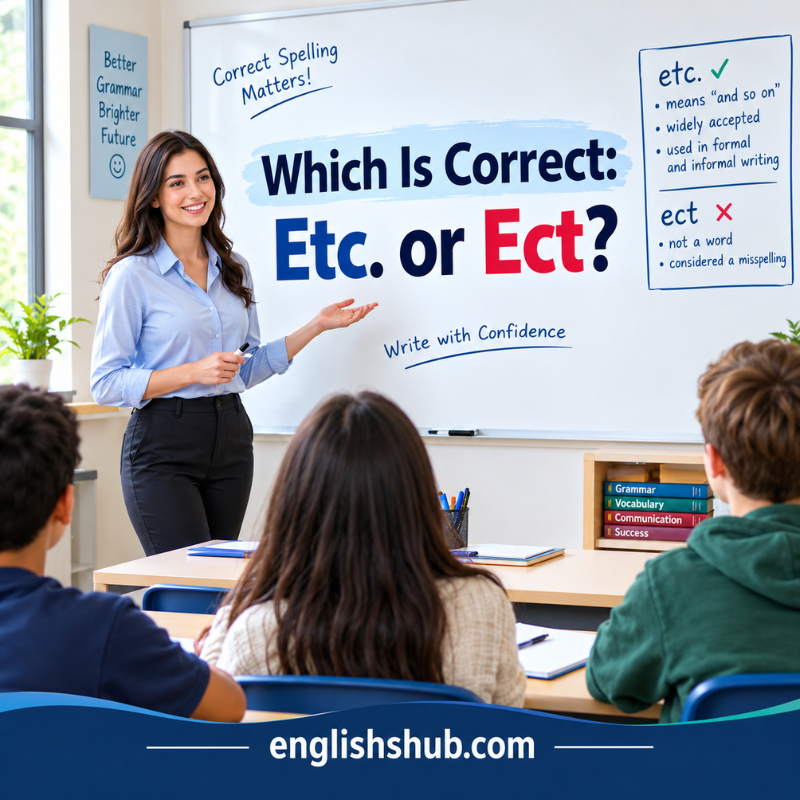
Etc. is correct when the intended phrase is et cetera.
The Merriam-Webster entry for etc.
identifies it as the abbreviation of that Latin phrase. Ect reverses the final two letters, so it does not represent the phrase accurately.
Correct:
- The desk contained pens, markers, paper clips, etc.
- We discussed the schedule, budget, guest list, etc.
Incorrect:
- The desk contained pens, markers, paper clips, ect.
- We discussed the schedule, budget, guest list, ect.
This is a standard spelling issue, not an American-versus-British difference. The same kind of letter-order error appears in
although each word needs its own memory method.
What Does Etc. Mean?
Etc. means “and the rest,” “and other similar things,” or “and so forth.” Writers place it after examples to show that a list continues without naming every item.
The full expression is et cetera. Its two Latin parts explain both the meaning and spelling:
- et = and
- cetera = the rest or remaining things
The Merriam-Webster entry for et cetera
defines it as “and others especially of the same kind” or “and so forth.” That same-kind idea matters.
Consider this sentence:
Pack warm clothing such as sweaters, gloves, scarves, etc.
Here, readers can infer other winter clothing. The abbreviation saves space without hiding essential information.
Why Do People Write Ect?
Writers often type ect because the spoken phrase can be hard to divide into words. Some speakers say something close to “ek-SET-ra,” which places a k sound before the t. That pronunciation can encourage the written order ect.
Standard pronunciation begins with et. Merriam-Webster gives pronunciations close to /et ˈse-tə-rə/ and /et ˈse-trə/. A simple American-English guide is et-SET-uh-ruh.
The spelling is easier when you ignore the mistaken k sound and look at the source phrase:
ET + C(ETERA) = ETC.
Fast typing can also reverse nearby letters, just as writers may accidentally produce atleast instead of the standard two-word phrase. The EnglishsHub guide to
shows why checking the word’s structure is safer than trusting visual familiarity.
How to Use Etc. in a List
Use etc. when your examples form a recognizable group and the omitted items are easy to imagine. A useful check is SAME:
- S — Similar: Do the named items belong together?
- A — Additional: Are more items possible?
- M — Meaningful: Can the reader infer what kind of items are missing?
- E — End: Does etc. appear after the examples rather than before them?
Clear:
The club offers chess, robotics, photography, etc.
The examples are all club activities, so the missing category is clear.
Weak:
Please bring a laptop, patience, lunch, etc.
The objects and abstract quality do not form one obvious category. A clearer sentence would name the remaining needs or introduce a broader label: “Please bring the materials listed in your welcome email.”
Two or more examples usually establish the pattern more clearly than one. Still, clarity—not an arbitrary count—is the real test.
How to Punctuate Etc. Correctly
In standard American prose, write etc. with a period because it is an abbreviation.
The Grammarly punctuation guide for etc.
also illustrates commas and sentence-ending marks around it.
| Position | Pattern | Example |
|---|---|---|
| End of a sentence | One period only | We packed towels, soap, sunscreen, etc. |
| Middle of a sentence | etc., when the grammar needs a comma | Towels, soap, etc., were already packed. |
| End of a question | Period plus question mark | Did you pack towels, soap, sunscreen, etc.? |
| Inside parentheses | Period stays with the abbreviation | Bring beach supplies (towels, soap, etc.). |
Do not add a second period when etc. ends a declarative sentence.
Incorrect:
We packed towels, soap, sunscreen, etc..
Correct:
We packed towels, soap, sunscreen, etc.
Punctuation styles can differ across publications, especially outside U.S. English. Therefore, follow an assigned style guide when it gives a specific rule.
Do Not Write “And Etc.”
Avoid and etc. in normal edited prose because the phrase already contains the Latin word et, meaning “and.” Writing and etc. effectively repeats the conjunction.
Redundant:
The kit includes tape, scissors, glue, and etc.
Correct:
The kit includes tape, scissors, glue, etc.
Also correct:
The kit includes tape, scissors, glue, and other supplies.
The Collins usage note for et cetera
likewise explains that adding and is unnecessary. The same source advises against repeating etc., etc. except when a deliberately informal effect is intended.
Etc. in Formal and Academic Writing
Etc. can appear in formal writing, but precision matters more than the abbreviation itself. Use it when omitted examples are predictable and unimportant. Replace it when the reader needs a complete list, exact requirements, or reproducible details.
Acceptable in a general report:
The office reduced spending on paper, toner, folders, etc.
Too vague for instructions:
Submit your passport, application, fee, etc.
The second sentence leaves applicants unsure about required documents. A complete checklist would be better.
Use these questions before keeping etc.:
- Could an omitted item affect a grade, payment, result, or decision?
- Does the reader need to repeat a process exactly?
- Is the category broad or unclear?
- Does a style guide discourage unexplained abbreviations?
If any answer is yes, finish the list or name the category directly.
Etc., E.g., Et Al., and “And So On”
These expressions are related, but they do different jobs.
| Expression | Main Job | Example |
|---|---|---|
| etc. | Shows a list continues | Bring pens, pencils, markers, etc. |
| and so on | Spells out a similar continuing idea | The pattern repeats: red, blue, green, and so on. |
| e.g. | Introduces examples | Choose a warm color, e.g., red or orange. |
| et al. | Means “and others,” often in names or citations | Rivera et al. reported the result. |
Do not automatically combine e.g. with etc. in one short example list. E.g. already tells readers that the items are examples, while etc. says more items remain. One clear signal is usually enough.
Also, do not use etc. as a careless substitute for et al. after a list of named authors. Citation styles have specific rules for author names, so follow the required manual.
When ECT Is Actually Correct
Uppercase ECT can be correct when it is an initialism with its own meaning. For example,
the Merriam-Webster entry for ECT
records it as an abbreviation for electroconvulsive therapy. Other organizations or technical fields may define the same letters differently.
Compare:
- Incorrect for et cetera: We need paper, ink, folders, ect.
- Correct abbreviation: The medical text defines ECT before using the initials.
This exception does not make lowercase ect an alternative spelling of etc. Capitalization, subject area, and a stated expansion identify the initialism. In general writing, if you mean “and the rest,” choose etc.
Common Etc-or-Ect Mistakes and Corrections
Reversing the letters
Incorrect: We ordered cups, plates, napkins, ect.
Correct: We ordered cups, plates, napkins, etc.
Dropping the period in U.S. prose
Less suitable for the site’s U.S. style: We ordered cups, plates, napkins, etc
Preferred: We ordered cups, plates, napkins, etc.
Adding a second period
Incorrect: The store sells coats, hats, gloves, etc..
Correct: The store sells coats, hats, gloves, etc.
Writing “and etc.”
Incorrect: The course covers nouns, verbs, adjectives, and etc.
Correct: The course covers nouns, verbs, adjectives, etc.
Using etc. after a complete list
Misleading: The four seasons are spring, summer, fall, winter, etc.
Correct: The four seasons are spring, summer, fall, and winter.
The original list is already complete, so etc. wrongly suggests more seasons. Careful proofreading also matters in ordinary plural spelling, as shown in
A Simple Memory Trick
Remember the full phrase, not the sound:
ET gives you ET. Cetera gives you C. Together: ETC.
You can also say:
Et Then Continues → ETC.
The first method reflects the real Latin spelling, while the second is only a memory sentence. After writing the abbreviation, check three things:
- The letters appear in the order E-T-C.
- A period follows the C in U.S. prose.
- The examples belong to one clear category.
For another guide that separates a preferred spelling from a tempting alternative,
see barbeque or barbecue.
FAQs
No. Lowercase ect is not the standard abbreviation of et cetera. Use etc. for “and the rest.” Uppercase ECT may be a separate initialism in a specialized context, but it does not replace etc.
In standard American prose, yes: write etc. A publication following another regional or house style may omit abbreviation periods in some contexts. For EnglishsHub’s U.S. audience, retaining the period is the safest default.
In a normal American series, place a comma between the final listed item and etc.: “pens, pencils, markers, etc.” If the sentence continues and its grammar requires a comma, another comma may follow: “Pens, pencils, etc., are provided.”
Yes. When etc. ends a declarative sentence, its abbreviation period also closes the sentence. Do not add another one. If the sentence is a question, add the question mark after it: “Did you bring towels, soap, etc.?”
Avoid it in edited writing. The Latin word et already means “and,” so and etc. repeats the same idea. Write either “pens, pencils, etc.” or “pens, pencils, and other supplies.”
It can be, but use it only when the missing items are obvious and unimportant. In academic or technical work, complete the list when readers need exact categories, requirements, methods, or results.
Test Your Understanding
- Which form correctly abbreviates et cetera in standard American prose?
A. ect
B. etc.
C. etc..
D. ect. - Which sentence avoids redundancy?
A. Bring paper, pens, and etc.
B. Bring paper, pens, etc.
C. Bring etc. paper and pens.
D. Bring paper, pens, etc., etc. - Which sentence ends correctly?
A. We bought fruit, bread, milk, etc..
B. We bought fruit, bread, milk, ect.
C. We bought fruit, bread, milk, etc.
D. We bought fruit, bread, milk, etc, - When should a writer replace etc. with a complete list?
A. When every omitted item is unimportant
B. When the reader needs exact requirements
C. Whenever the sentence contains a comma
D. Whenever the list has three examples - Which statement about uppercase ECT is accurate?
A. It is always another spelling of etc.
B. It should replace etc. in formal writing.
C. It can be a specialized initialism with a different meaning.
D. It means et cetera only in British English.
Answer Key
- B — etc. The letters follow et cetera, and American prose normally retains the period.
- B — Bring paper, pens, etc. The abbreviation already contains the meaning “and.”
- C — We bought fruit, bread, milk, etc. One period serves both the abbreviation and the sentence ending.
- B — When the reader needs exact requirements. A vague ending can hide necessary information.
- C — It can be a specialized initialism with a different meaning. Context and capitalization separate it from etc.
Conclusion
For etc or ect, choose etc. when you mean et cetera, or “and the rest.” The source phrase preserves the correct E-T-C order, and standard American prose normally keeps the final period. Use the abbreviation only after a clear group of examples, avoid and etc., and do not add a second sentence-ending period. Uppercase ECT can have a separate specialized meaning, but lowercase ect is not the correct abbreviation for et cetera.
Related Grammar and Language Guides
Camouflage or Camoflauge: Correct Spelling Made Easy
At Least or Atleast: Correct Spelling and Usage
Attornies or Attorneys: Which Spelling Is Correct?