

If you are deciding between favor or favour, both spellings are correct. The difference is mainly regional: favor is the standard spelling in American English, while favour is the standard spelling in British English. The meaning does not normally change when the spelling changes. Cambridge lists favor as the U.S. form of favour and recognizes the word as both a noun and a verb.
For a U.S. audience, use favor. For British English, use favour. The same regional pattern appears in related words such as favorite/favourite and favorable/favourable.
The key is not to treat favour as a misspelling everywhere. It is the normal British form. Instead, choose the spelling system that matches your audience, publication, school, or style guide.
Quick Answer
Favor is the standard American English spelling, while favour is the standard British English spelling. Both forms can mean an act of kindness, support or approval, an advantage, or a preference. As a verb, both can mean “to prefer” or “to support.” For U.S. writing, choose favor and keep related forms consistent.
TL;DR
- Favor is standard in American English.
- Favour is standard in British English.
- Both spellings have the same basic meanings.
- The noun can mean help, support, approval, or an advantage.
- The verb can mean prefer, support, or give an advantage.
- Related forms should follow the same regional spelling system.
Favor vs. Favour at a Glance
| Feature | Favor | Favour |
|---|---|---|
| Main variety | American English | British English |
| Basic meaning | Same | Same |
| Noun | Yes | Yes |
| Verb | Yes | Yes |
| Common phrase | do me a favor | do me a favour |
| Related adjective | favorable | favourable |
| Past form | favored | favoured |
| -ing form | favoring | favouring |
| Best choice for U.S. writing | Yes | Usually no |
Cambridge explicitly labels favor as the U.S. spelling and favour as the U.K. spelling.
Are Favor and Favour the Same Word?
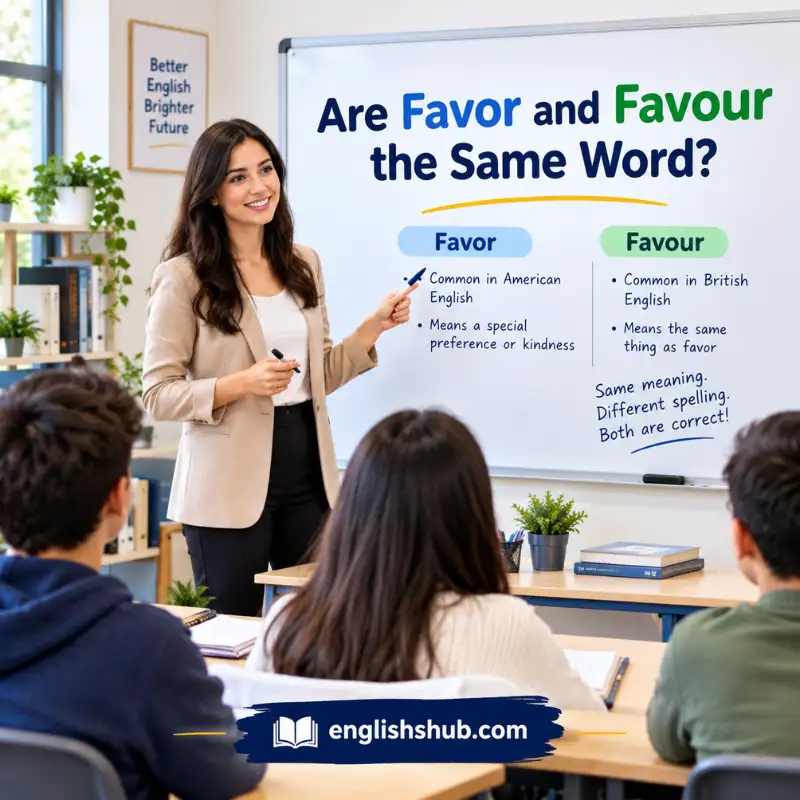
Yes. Favor and favour are regional spelling variants of the same English word. The extra u does not create a different meaning.
For example:
- American: Can you do me a favor?
- British: Can you do me a favour?
Both sentences ask someone to do something helpful.
The same distinction applies when the word means support:
- American: The proposal has gained favor.
- British: The proposal has gained favour.
It also applies when the word means preference:
- American: I favor the simpler design.
- British: I favour the simpler design.
Cambridge gives favor/favour noun senses involving support, approval, helpful acts, presents, and advantages. Its verb entries include preference, support, unfair advantage, and related uses.
So, do not use meaning as the main way to choose between favor and favour. Use the English variety instead.
What Does Favor Mean as a Noun?
As a noun, favor has several related meanings in American English.
1. A helpful act
A favor can be something you do to help another person.
- Could you do me a favor?
- She asked her neighbor for a favor.
- I owe you a favor.
Here, favor means an act of help or kindness.
2. Support or approval
Favor can also mean approval or support.
- The proposal quickly gained favor with the committee.
- The new idea is gaining favor among students.
3. An advantage
The expression in your favor means that something gives you an advantage.
- The evidence is in your favor.
- The final decision worked in her favor.
4. Special treatment or an advantage given to someone
Favor can also describe preferential treatment.
- The policy should not show favor toward one group.
- The manager was accused of showing favor to certain employees.
These meanings are also found with favour in British English. The spelling changes, but the underlying word does not.
What Does Favor Mean as a Verb?
As a verb, favor commonly means to prefer or support one person, thing, idea, or possibility.
For example:
- I favor the second option.
- The committee favors the new proposal.
- Many customers favor simple designs.
The construction favor something over something else means to prefer one thing rather than another.
- The company favors quality over speed.
- She favors tea over coffee.
Cambridge specifically records the U.S. construction favor something over something for expressing preference.
The verb can also mean to give an advantage:
- The new design favors smaller spaces.
- The weather conditions favored the home team.
Another established use is favoring an injured body part, meaning avoiding pressure on it:
- He was favoring his left leg after the game.
British English uses favour in the same grammatical roles:
- I favour the second option.
- The committee favours the proposal.
- She is favouring her injured leg.
Why Does American English Use Favor?
The difference belongs to a larger spelling pattern between American and British English.
Many words use -or in American English and -our in British English:
| American English | British English |
|---|---|
| color | colour |
| honor | honour |
| labor | labour |
| neighbor | neighbour |
| behavior | behaviour |
| favor | favour |
The important point is that favor is not a shortened or casual version of favour. It is the established American spelling.
Likewise, favour is not a random extra-letter version. It is the established British spelling.
That means:
U.S. English → favor
British English → favour
Similar regional spelling patterns are documented by Scribbr and QuillBot.
Favor and Favour in Common Phrases
Common expressions use the same regional spelling distinction.
Do me a favor
American English:
- Could you do me a favor?
- Do me a favor and close the window.
British English:
- Could you do me a favour?
- Do me a favour and close the window.
In favor of
American English:
- The committee voted in favor of the proposal.
British English:
- The committee voted in favour of the proposal.
In your favor
American English:
- The evidence is in your favor.
- The situation may work in our favor.
British English:
- The evidence is in your favour.
- The situation may work in our favour.
Out of favor
American English:
- The style has fallen out of favor.
British English:
- The style has fallen out of favour.
Cambridge lists expressions such as in favor of, in your favor, out of favor, and find favor under the U.S. spelling.
Related Forms: Favorite, Favorable, Favored, and Favoring
The regional difference continues in many related forms.
| American English | British English | Example |
|---|---|---|
| favor | favour | She asked me for a favor. |
| favorite | favourite | Blue is my favorite color. |
| favorable | favourable | The proposal received favorable reviews. |
| favored | favoured | The plan was favored by the committee. |
| favoring | favouring | The evidence is favoring one explanation. |
| favorably | favourably | The proposal was viewed favorably. |
| disfavor | disfavour | The policy fell into disfavor. |
| unfavorable | unfavourable | The conditions were unfavorable. |
For example, mixing the systems can create an inconsistent sentence:
Mixed: The project was a favorite but received an unfavourable review.
For American English, write:
Consistent U.S.: The project was a favorite but received an unfavorable review.
For British English, write:
Consistent British: The project was a favourite but received an unfavourable review.
Scribbr and QuillBot both document this broader word-family distinction.
Favor vs. Related Words: Synonyms and Contrasts
The word favor has several related words, but they are not interchangeable in every sentence.
Useful synonyms and near-synonyms
Depending on the sense, possible alternatives include:
| Favor sense | Possible alternative | Substitution limit |
|---|---|---|
| A helpful act | help, kindness | “Do me a help” does not replace “do me a favor.” |
| Support | support, approval | Approval does not always mean active support. |
| Preference | preference, choice | Preference is normally a noun, while favor can be a verb. |
| Prefer | prefer | Prefer does not carry the “helpful act” noun sense. |
| Advantage | benefit, advantage | These words do not fit every idiom involving favor. |
For example:
- Can you do me a favor?
→ Natural. - Can you do me a kindness?
→ Grammatically possible, but it does not sound like the ordinary expression. - I favor the blue design.
→ Natural. - I prefer the blue design.
→ Also natural, but prefer directly expresses the choice rather than using favor.
Contextual opposites can include disfavor, opposition, or rejection, depending on the particular sense. These are not universal antonyms because favor has several meanings.
The key rule is simple: choose a synonym based on the specific meaning, not merely because it appears in a dictionary’s related-word list.
Common Mistakes With Favor and Favour
1. Using favour in ordinary American writing
If your document follows American English, use favor.
Less suitable for standard U.S. style:
- Please do me a favour.
U.S. style:
- Please do me a favor.
2. Mixing regional spellings
Avoid switching between American and British forms without a reason.
Inconsistent:
- My favorite restaurant received a favourable review.
American English:
- My favorite restaurant received a favorable review.
British English:
- My favourite restaurant received a favourable review.
3. Assuming favour has a different meaning
It does not normally have a separate meaning simply because it contains u.
- favor = American spelling
- favour = British spelling
4. Changing a quotation
If a British source says:
“The decision was in our favour.”
Do not silently change favour to favor inside the quotation merely because the surrounding article uses American English.
The original spelling can be preserved because it belongs to the quoted source.
5. Treating spell-check as the final authority
A U.S. spell-checker may flag favour. A British English spell-checker may prefer favour over favor.
That does not mean one form is universally wrong. It means the language setting is applying a regional spelling convention.
How to Choose Favor or Favour
Use this three-step rule:
Step 1: Identify your audience.
If you are writing for U.S. readers, choose favor.
Step 2: Check the required style.
If your school, employer, publisher, or organization follows British English, use favour.
Step 3: Stay consistent.
Once you choose a regional spelling system, carry it through related forms.
For example:
American English
- favor
- favorite
- favorable
- favored
- favoring
British English
- favour
- favourite
- favourable
- favoured
- favouring
The shortest memory aid is:
Favor = U.S.
Favour = U.K.
The extra u can remind you of U.K.
FAQs
Favor is the standard American English spelling. Favour is the standard British spelling. American readers generally understand both, but U.S. writing normally uses favor.
No. Favour is a standard British English spelling. It becomes inappropriate mainly when it conflicts with the spelling system required for a particular document, such as standard American English.
Yes. They are regional spellings of the same word. Both can function as nouns and verbs, with meanings involving help, support, approval, preference, advantage, and related ideas.
Use in favor of in American English and in favour of in British English. The meaning is the same.
Yes. Favorite is the American form, while favourite is the British form. The same regional distinction appears in favorable/favourable and favored/favoured.
Yes, when there is a clear reason, such as comparing U.S. and British English or preserving a quotation. Otherwise, choose one regional spelling system and use it consistently.
American students should normally use favor in English essays, assignments, reports, and other U.S.-style writing. If an assignment specifically requires British English, follow that requirement instead.
Test Your Understanding
1. Which spelling is standard in American English?
A. Favour
B. Favor
C. Favur
D. Faver
2. Which sentence follows American English spelling?
A. Can you do me a favour?
B. The committee voted in favour of the proposal.
C. Can you do me a favor?
D. She is my favourite teacher.
3. What does “I favor the blue design” mean?
A. I repaired the blue design.
B. I prefer or support the blue design.
C. I gave the blue design to someone.
D. I copied the blue design.
4. Which sentence is consistent with American English?
A. My favorite restaurant received a favourable review.
B. My favourite restaurant received a favorable review.
C. My favorite restaurant received a favorable review.
D. My favourit restaurant received a favorable review.
5. When is it appropriate to keep “favour” in an American-English article?
A. Always, because favour is more formal
B. Never, because favour is not an English word
C. When preserving a British quotation or required official wording
D. Only when the word is used as a verb
Answer Key
- B. Favor is the standard American English spelling.
- C. Favor is the U.S. spelling in “do me a favor.”
- B. Here, favor means to prefer or support the blue design.
- C. Favorite and favorable are both the American forms.
- C. A quotation or official wording may require the original British spelling.
Conclusion
When choosing favor or favour, the correct form depends mainly on the English variety. Use favor for American English and favour for British English. Both forms have the same basic meanings and grammatical functions. The distinction also carries into related words such as favorite/favourite, favorable/favourable, and favored/favoured. For U.S. writing, the easiest rule is simple: choose favor, use its American related forms, and stay consistent throughout the document.



[…] Favor or Favour? Correct Spelling and Usage […]