
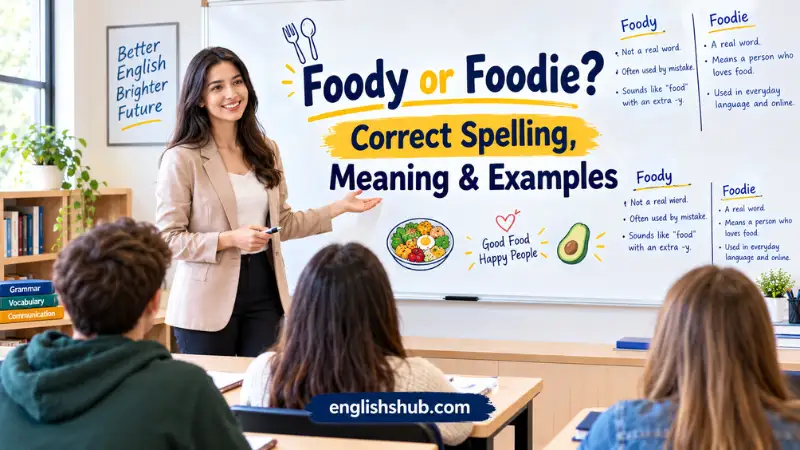
When choosing between foody or foodie, write foodie in standard American English. A foodie is a person with a strong interest in food, cooking, restaurants, cuisines, ingredients, or food trends. The spelling foody also appears in respected dictionaries, but it is a less familiar alternative and may look like a mistake to many readers.
The two spellings do not normally identify different kinds of people. Instead, the main difference is usage: foodie is the widely expected form for articles, captions, profiles, restaurant content, and everyday communication. Keep Foody when it belongs to an official brand, app, title, username, or exact quotation. Otherwise, foodie is the clearest choice.
Quick Answer
For foody or foodie, choose foodie in ordinary writing. Foody is recorded as an alternative spelling by some major dictionaries, so it is not always meaningless or impossible. However, foodie is the familiar and preferred form for a person interested in food. Preserve Foody only when an official name or exact quotation requires it.
TL;DR
- Foodie is the preferred modern spelling.
- Foody is a recognized but uncommon alternative.
- A foodie has an active interest in food culture.
- The plural is foodies, not foodys or foodie’s.
- Foodie is informal but widely understood.
- Preserve Foody in verified names and exact quotations.
Foody and Foodie at a Glance
| Context | Best Choice | Example or Reason |
|---|---|---|
| General American English | foodie | Maya is a curious foodie. |
| Food blog or restaurant review | foodie | The market attracts adventurous foodies. |
| Formal professional profile | food enthusiast or culinary enthusiast | The alternative may sound more polished. |
| Recognized variant in quoted text | foody | Preserve the quotation accurately. |
| Brand, app, username, or title | Official spelling | Proper names may intentionally use Foody. |
| More than one person | foodies | Add s to foodie: foodies. |
Which Spelling Is Correct: Foody or Foodie?
Foodie is the preferred spelling for most modern English writing.
The Merriam-Webster definition of foodie
uses it as the main headword for a person with an avid interest in food and food trends. That spelling is also the one most readers expect in food media, lifestyle writing, restaurant reviews, and social posts.
Correct and preferred:
- My sister is a foodie who enjoys regional Mexican cooking.
- The festival brought foodies from across the state.
- His foodie guide focuses on family-owned restaurants.
Recognized but less familiar:
- My sister is a foody.
The final sentence can be understood, and dictionaries do record the spelling. Still, many readers may assume that it is a typo. Therefore, use foodie unless you have a specific reason to preserve foody.
This is a preference question, not a difference in meaning. The pair resembles the choice discussed in EnglishsHub’s guide to
dictionary status and editorial preference must be considered separately.
Is Foody a Real Word?
Yes, foody is recorded as an alternative spelling of foodie. It is inaccurate to claim that the letter sequence can never be correct.
The Oxford Learner’s entry for foody
defines it as an informal noun for a person interested in cooking and eating different kinds of food.
also presents foody as an alternative in its British English information.
However, dictionary recognition does not mean equal usefulness. Dictionaries record rare, regional, historical, informal, and alternative forms as well as preferred ones. In contemporary U.S. prose, foodie is easier to recognize and less likely to distract readers.
Use this distinction:
- Possible: foody appears in dictionary evidence and intentional names.
- Preferred: foodie is the normal default in general American English.
That careful approach also helps with pairs such as
where existence and everyday preference are separate questions.
What Does Foodie Mean?
A foodie is a person who has an enthusiastic interest in food. The interest may include cooking, ingredients, restaurants, food history, regional cuisines, techniques, presentation, or new dining experiences.
For example, a foodie might:
- compare different styles of barbecue;
- learn why a recipe uses a particular spice;
- visit a neighborhood to try its local dishes;
- follow restaurant openings or seasonal menus;
- practice baking, fermenting, grilling, or another technique;
- read about the history and culture behind a meal.
The word does not simply mean “a person who eats” or “someone who is hungry.” Nearly everyone enjoys some foods, but foodie suggests an active interest or hobby.
Compare:
- Luis loves pizza. This states one preference.
- Luis is a foodie who studies regional pizza styles. This describes a broader interest.
The noun is informal and usually positive or neutral. Still, some speakers dislike it because they find it trendy, vague, or self-important. Context and audience matter.
How to Use Foodie in Sentences
Foodie functions mainly as a countable noun. It can name one person or appear in the plural for a group.
Everyday conversation
- I’m a foodie, so I enjoy trying unfamiliar dishes.
- Priya became a foodie after she started cooking with her grandmother.
The first sentence presents food as a personal interest. The second connects that interest with cooking experience.
Travel and restaurant writing
- The neighborhood is a popular destination for foodies.
- Our foodie itinerary includes a farmers market and three family-run cafes.
In the second example, foodie appears before another noun. It still relates to people interested in food, but it helps describe the type of itinerary.
Social media and personal profiles
- Weekend hiker, coffee fan, and lifelong foodie.
- This page shares affordable recipes for busy foodies.
These uses sound natural because the setting is friendly and informal. In a formal biography, however, culinary enthusiast may fit better.
Foodie, Foodies, Foodie’s, and Foodies’
The spelling changes according to number and possession.
| Form | Function | Example |
|---|---|---|
| foodie | one person | A foodie recommended the cafe. |
| foodies | more than one person | Several foodies joined the tour. |
| foodie’s | belonging to one foodie | The foodie’s review was detailed. |
| foodies’ | belonging to multiple foodies | The foodies’ votes decided the winner. |
To form the plural, add -s to foodie: foodies. Do not write foodys. Also, do not use an apostrophe for an ordinary plural.
Incorrect: Three foodie’s attended the tasting.
Correct: Three foodies attended the tasting.
Use foodie’s only for singular possession:
- The foodie’s notebook contained restaurant addresses.
Use foodies’ for plural possession:
- The foodies’ favorite dish sold out first.
This same plural-versus-possessive distinction appears in EnglishsHub’s treatment of word forms
in Brasil or Brazil.
How to Pronounce Foodie and Foody
Both spellings are pronounced FOO-dee. The first syllable rhymes with mood, and the stress falls on that first syllable.
A common IPA form is:
/ˈfuːdi/
Because foodie and foody sound the same, pronunciation cannot help a listener identify the spelling. Writers must remember which written form is preferred.
The plural foodies sounds approximately like FOO-deez. The ending has a voiced z sound, even though it is spelled with s.
Where Did the Word Foodie Come From?
Foodie is a relatively recent English noun. Merriam-Webster records its first known use in 1980. The word combines food with the informal person-forming ending -ie.
That ending also appears in words such as newbie and groupie, although each word has its own history and tone. It often makes a label sound casual or familiar.
It is safest to say that foodie emerged around the start of the 1980s and quickly became associated with strong interest in dining and food culture. A first known printed use does not prove that one writer single-handedly invented the word. Therefore, avoid unsupported claims about a sole creator unless a historical source establishes them.
Is Foodie Formal or Informal?
Foodie is informal, but it is common and widely understood. It works naturally in restaurant articles, travel guides, lifestyle writing, conversations, captions, newsletters, and personal profiles.
Informal but natural:
- The tour is designed for adventurous foodies.
- I’m a foodie who loves learning family recipes.
More formal:
- The program serves culinary enthusiasts interested in regional cuisine.
- She has a strong professional interest in food culture and hospitality.
The informal label is not automatically unprofessional. A restaurant’s marketing page can use foodie effectively. However, a résumé, academic paper, grant application, or formal biography may benefit from a more exact phrase.
Choose based on audience, not on a belief that foodie is grammatically wrong.
Foodie vs. Food Lover, Gourmet, and Similar Terms
These expressions overlap, but they are not perfect substitutes.
| Term | Typical Meaning and Tone | Best Context |
|---|---|---|
| foodie | Informal person with an active interest in food | Lifestyle writing, conversation, profiles |
| food lover | Broad, warm, and easy to understand | General audiences and friendly copy |
| food enthusiast | Neutral and slightly more formal | Bios, events, professional descriptions |
| culinary enthusiast | Polished interest in cooking or cuisine | Formal profiles and program descriptions |
| gourmet | Person with refined knowledge or taste; can also describe high-quality food | Fine dining and specialized contexts |
| gastronome | Formal, uncommon term for a knowledgeable food lover | Literary or specialist writing |
A person can be a foodie without claiming expert taste. By contrast, gourmet often suggests refinement or discrimination. Therefore, replacing one with the other may change the tone.
Compare:
- The street-food tour attracts curious foodies.
- The tasting panel includes experienced gourmets.
The first group may simply enjoy exploration. The second is presented as having more developed judgment.
Foody or Foodie in American and British English
Foodie is a safe and familiar choice in both American and British English. This is not a fixed regional split in which Americans must use one form and British writers must use the other.
Natural American English:
- Chicago offers plenty for an adventurous foodie.
Natural British English:
- The market has become a popular destination for foodies.
British-oriented dictionaries may record foody, but that does not make it the required British spelling. If you write for an international audience, foodie remains the clearest default.
Each spelling pair needs its own evidence. For example, language and region matter differently in
where pronunciation and grammar create other choices.
When Foody Should Be Preserved
Use Foody when it is part of a verified proper name or when you reproduce someone’s exact wording. Accuracy takes priority over the general spelling preference.
Possible situations include:
- a restaurant or food-delivery brand;
- an app or product name;
- a username or social handle;
- a book, article, event, or creative title;
- an exact quotation;
- a fictional character’s name.
Suppose an app is officially called “Foody.” Do not silently change it to “Foodie” in a review. The unusual spelling is part of the name.
However, a proper-name exception does not change the normal noun:
- Correct: I used the Foody app to find restaurants.
- Correct: I’m a foodie who enjoys trying new restaurants.
One sentence contains a name; the other contains the common noun.
Common Foody-or-Foodie Mistakes and Corrections
Calling foody impossible
Overstated: Foody is never a real word.
Accurate: Foody is a recorded alternative, but foodie is the preferred general spelling.
Treating the spellings as different meanings
Misleading: A foodie likes fine dining, while a foody likes comfort food.
Accurate: The spellings normally refer to the same kind of person. No standard meaning distinction separates them.
Using foodie to mean delicious
Incorrect: That pasta tastes very foodie.
Better: That pasta tastes delicious.
Foodie normally refers to a person or works attributively in phrases such as foodie destination. It does not simply mean “tasty.”
Forming the plural with an apostrophe
Incorrect: The event welcomed hundreds of foodie’s.
Correct: The event welcomed hundreds of foodies.
Using foodie for anyone who eats a lot
Weak: Ben ate two burgers, so he is a foodie.
Better: Ben is a foodie who studies regional burger styles and tests new recipes.
The word suggests interest, not merely appetite or quantity.
Rewriting an intentional name
Incorrect: Changing an official brand from Foody to Foodie.
Correct: Preserve the verified name while using foodie for the common noun.
An Easy Rule to Remember
Use this three-step check:
- Do you mean a person interested in food? Write foodie.
- Do you need a formal tone? Consider food enthusiast or culinary enthusiast.
- Is the word part of a verified name or quotation? Preserve the original spelling.
The shortest memory aid is:
A person who loves food is a foodIE.
The final -ie marks the familiar noun. For more than one person, add s: foodies.
FAQs
Foodie is the preferred spelling for a person with a strong interest in food. Foody is recorded as an alternative by some dictionaries, but it is much less familiar. Use foodie in ordinary American English.
Yes. Oxford Learner’s Dictionaries and Collins record foody as an alternative form. Still, many readers may view it as unusual or mistaken, so foodie remains the safer choice unless a proper name or quotation uses foody.
A foodie is someone with an enthusiastic interest in food, cooking, restaurants, cuisines, ingredients, or food culture. The word suggests an active interest rather than simply hunger, appetite, or enjoyment of one favorite dish.
The plural is foodies. Add s to foodie: one foodie, two foodies. Do not write foodys or use an apostrophe for the ordinary plural.
Foodie is an informal noun and is sometimes labeled slang. However, it is widely understood and common in food, travel, restaurant, and lifestyle writing. A more formal context may favor food enthusiast or culinary enthusiast.
Not exactly. Foodie broadly describes an interested food lover. Gourmet often suggests refined taste, knowledge, or appreciation of high-quality food. A person may fit both descriptions, but the words carry different implications.
Yes. A business, app, event, title, or username may intentionally use Foody. Preserve the official spelling when referring to that name. The standard common noun in your own prose should still be foodie.
Test Your Understanding
- Which sentence uses the preferred common-noun spelling?A. Rina is a foody who visits new restaurants.B. Rina is a foodie who visits new restaurants.C. Rina is a fooddy who visits new restaurants.D. Rina is a foodee who visits new restaurants.
- Which statement about foody is most accurate?A. It always means a person who prefers comfort food.B. It is required in British English.C. It is a recorded alternative, but foodie is usually preferred.D. It is the plural of foodie.
- Which sentence forms the plural correctly?A. Several foodie’s attended the event.B. Several foodys attended the event.C. Several foodies’ attended the event.D. Several foodies attended the event.
- Which phrase is most suitable for a formal professional biography?A. Serious foodyB. Culinary enthusiastC. Person who eats lotsD. Foodie-ish person
- When should an editor preserve the spelling Foody?A. Whenever the audience is BritishB. Whenever the word is pluralC. When it is the verified spelling of a brand or titleD. In every academic paper
Answer Key
- B — Foodie is the preferred spelling for the common noun in standard modern English.
- C — Major dictionaries record foody, but foodie is the clearer general choice.
- D — The ordinary plural is foodies, with no apostrophe.
- B — Culinary enthusiast sounds more polished and specific in a formal biography.
- C — Editors should preserve the verified spelling of a proper name or title.
Conclusion
For foody or foodie, choose foodie in normal American English. It is the familiar spelling for a person actively interested in food, cooking, restaurants, or culinary culture. Foody is a recorded alternative, so it should not be called impossible, but it remains an uncommon default. Remember the forms foodie, foodies, foodie’s, and foodies’. Use a more formal alternative when your audience requires it, and preserve Foody when it belongs to an official name or exact quotation.
Related Grammar and Language Guides
Donut or Doughnut? Correct Spelling and Clear Usage
Brasil or Brazil: Correct Spelling and Usage Guide
Crummy or Crumby: Meaning, Difference & Usage