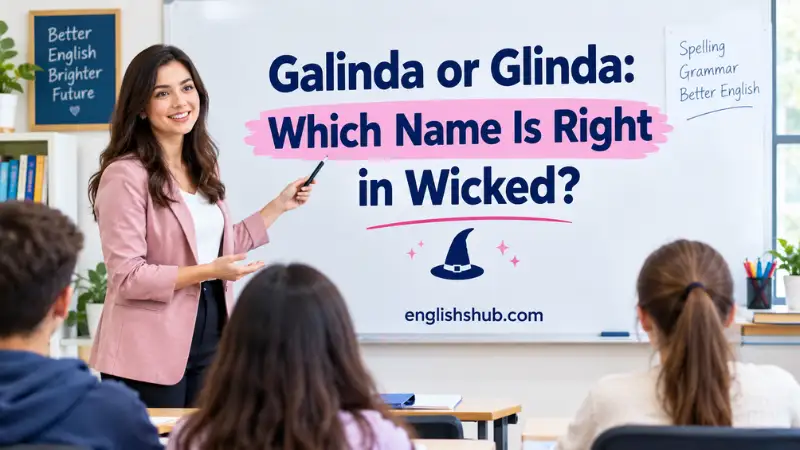
Galinda or Glinda? Both names can be correct. In Wicked, Galinda is the name the character uses earlier in the story. She later chooses Glinda, the name audiences also know from the older Oz story. The extra a marks a change in her name; it is not a choice between American and British spelling.
The right form depends on what you mean. Use Galinda when discussing her earlier life at Shiz University or the moment she changes her name. Use Glinda for her later identity or for a general reference to the famous Oz character. If your reader may not know the connection, introduce her as “Galinda, later known as Glinda.”
Quick Answer
In Wicked, Galinda and Glinda are the same character. She starts out as Galinda and later takes the name Glinda. Doctor Dillamond’s way of saying her name helps explain that choice. In L. Frank Baum’s earlier The Wonderful Wizard of Oz, the character’s name is Glinda. Choose the form that matches the story and point in her life you are describing.
TL;DR
- Galinda is her earlier name in Wicked.
- Glinda is the name she adopts later in Wicked.
- Baum’s original Oz book calls her Glinda.
- Both are proper names, so capitalize them.
- For a general introduction, write “Galinda, later Glinda.”
Galinda vs. Glinda at a Glance
| Context | Best choice | Example |
|---|---|---|
| Her early days at Shiz in Wicked | Galinda | “Galinda meets Elphaba at Shiz.” |
| The change in Wicked | Both | “Galinda begins calling herself Glinda.” |
| Her later identity in Wicked | Glinda | “Glinda reflects on her choices.” |
| Baum’s original The Wonderful Wizard of Oz | Glinda | “Dorothy seeks Glinda’s help.” |
| A general introduction for new readers | Both, once | “Galinda, later known as Glinda, is Elphaba’s friend.” |
Are Galinda and Glinda the Same Person?
Yes. Wicked uses both names for one character. NBCUniversal introduces the film character as Galinda Upland, later known as Glinda the Good. The official stage production’s education kit also lists her as “Galinda / Glinda.”
Think of the names as clues to the part of her story being discussed. Galinda usually points to her earlier identity. Glinda points to the name she later chooses and the identity more people recognize. They do not name two friends, sisters, or separate witches.
That distinction matters in a sentence about change:
Clear: “Galinda changes her name to Glinda.”
Writing “Glinda changes her name to Glinda” hides the very change you are trying to explain.
Why Does Galinda Change Her Name to Glinda?
In the stage version of Wicked, Doctor Dillamond repeatedly says her name as “Glinda.” Galinda later adopts that form in deference to him. The official Wicked education kit identifies his mispronunciation as the reason for her change of name.
That is why dropping the a matters to the story. It connects the name to a relationship and a choice the character makes. It is more precise to describe the change this way than to say a writer simply corrected a spelling error.
You can explain it without revealing more plot than needed:
“Galinda takes the name Glinda, using the way Doctor Dillamond says her name.”
Avoid claiming that every Oz version shows this event. The explanation belongs to Wicked’s telling of the character’s past.
Which Name Appears in the Original Oz Book?
L. Frank Baum’s The Wonderful Wizard of Oz uses Glinda. Dorothy travels to see her near the end of the book. Galinda is not the name Baum uses for her in that original story.
This is an easy place to mix adaptations together. Wicked gives the familiar Oz character an earlier life and a name change. Baum’s book presents Glinda without that Wicked backstory.
If you are writing about Baum’s text, say:
“Dorothy visits Glinda.”
If you are writing about the character’s earlier Wicked story, say:
“Galinda studies at Shiz University.”
Also check which version you mean before adding a directional title. Baum’s original book places Glinda in the South; the opening Good Witch in the North is a different character. That detail is worth keeping accurate in a book report.
Which Name Should You Use in Wicked?
Use Galinda when the earlier name itself matters. Use Glinda when discussing her later name or referring broadly to the character. Neither choice is automatically wrong just because your sentence mentions Wicked.
For example, a review might say, “Glinda is one of the main characters in Wicked.” That general reference is clear. A close description of an early Shiz scene might instead say, “Galinda tries to impress her classmates.” The second sentence locates her at an earlier point in the story.
A simple decision rule is:
- Are you describing her before the name change? Use Galinda if that timing matters.
- Are you describing the change? Use both names.
- Are you naming the character generally or after the change? Glinda is clear.
When you discuss a specific production, quotation, program, or credit, follow the name that source uses. A cast listing may use Glinda even though the story contains earlier scenes in which characters call her Galinda.
How to Write the Name in Your Own Sentence
Choose the name that gives your reader the right point in the story. When both names appear in one piece of writing, explain their connection the first time.
| Less clear | Clearer | Why |
|---|---|---|
| “Galinda and Glinda become friends with Elphaba.” | “Galinda, later known as Glinda, becomes friends with Elphaba.” | There is one character, not two. |
| “Galinda helps Dorothy in Baum’s original book.” | “Glinda helps Dorothy in Baum’s original book.” | Baum uses Glinda. |
| “Glinda changes her name to Glinda.” | “Galinda changes her name to Glinda.” | Both forms show the change. |
| “Galinda is a misspelling in Wicked.” | “Galinda is her earlier name in Wicked.” | The spelling is intentional in that story. |
For a short caption, “Galinda becomes Glinda” may be enough. For a school paragraph, give readers one more line of context:
“In Wicked, Galinda later chooses the name Glinda after Doctor Dillamond repeatedly calls her by that form.”
Then use the name that fits the scene you discuss. You do not need to explain the change again in every paragraph.
Pronunciation, Capitalization, and Common Mix-Ups
Galinda has an extra vowel in both its written form and its spoken form in Wicked. A simple pronunciation guide is guh-LIN-duh for Galinda and GLIN-duh for Glinda. These are reading aids, not official IPA transcriptions. Doctor Dillamond’s shortened pronunciation is part of the name-change story.
Both forms are proper names, so begin them with capital letters in ordinary sentences:
- Correct: “Galinda meets Elphaba.”
- Correct: “Glinda is an Oz character.”
- Incorrect in ordinary prose: “galinda meets Elphaba.”
These names are not regional versions of a common English word. A comparison such as color/colour concerns spelling conventions across varieties of English. Galinda/Glinda concerns a character’s name and story context. Neither name has a useful antonym, and a description such as the Good Witch cannot replace the name in every sentence.
FAQs
Both. She uses Galinda earlier and Glinda later. For a broad reference to the character, Glinda is also clear. Use Galinda when her earlier name or the timing of a scene matters.
No. Galinda is an intentional name in Wicked. If you are writing about Baum’s original Oz book, however, use Glinda, because that is the name in that text.
The official Wicked education kit says he mispronounces Galinda’s name. She later changes her name to the form he uses.
No. Within Wicked, the two names refer to one character at different points in her story.
Name the book you are reporting on. For Baum’s The Wonderful Wizard of Oz, write Glinda. For a report on Wicked, use Galinda for her earlier identity and Glinda after the change. Explain the connection when you first use both names.
No regional spelling rule explains this pair. The difference comes from which name the character uses in the story, not from an American-versus-British English convention.
Test Your Understanding
1. Which name does Baum use in The Wonderful Wizard of Oz?
A. Galinda
B. Glinda
C. Galindah
D. Both Galinda and Glinda as a name-change pair
2. Which sentence best explains the change in Wicked?
A. Glinda becomes a different witch named Galinda.
B. Galinda changes her name to Glinda.
C. British English changes Galinda to Glinda.
D. Galinda is a printing error.
3. Which name is most precise for her earlier time at Shiz, when that timing matters?
A. Galinda
B. Dorothy
C. The Wizard
D. Elphaba
4. Which introduction helps a reader who knows only one of the names?
A. “Galinda and Glinda are two students.”
B. “Glinda, later known as Galinda, is a student.”
C. “Galinda, later known as Glinda, is a student.”
D. “galinda and glinda are both common nouns.”
5. Is “Glinda is a main character in Wicked” necessarily wrong?
A. Yes, because Glinda appears only in Baum’s book.
B. Yes, because character names must be lowercase.
C. No, because Glinda is also her name in Wicked.
D. No, because the two names belong to separate characters.
Answer Key
- B — Glinda. That is the name used in Baum’s original book.
- B — Galinda changes her name to Glinda. The sentence identifies both forms and their order.
- A — Galinda. It identifies her earlier Wicked name.
- C — “Galinda, later known as Glinda.” It connects the names without suggesting two people.
- C — No. Glinda is also an appropriate general reference to the character in Wicked.
Conclusion
Choose Galinda or Glinda by checking the story and the moment you mean. Baum’s original Oz book uses Glinda. In Wicked, the character starts as Galinda and later chooses Glinda, following Doctor Dillamond’s pronunciation. When you need to explain both names to a new reader, write “Galinda, later known as Glinda” once, then use the name that fits your discussion.
Related Grammar and Language Guides
Segway or Segue: A Clear Guide With Simple Examples
Matt or Mat: Meaning, Difference, and Correct Usage
Kurt or Curt: Meaning, Difference, and Correct Use